
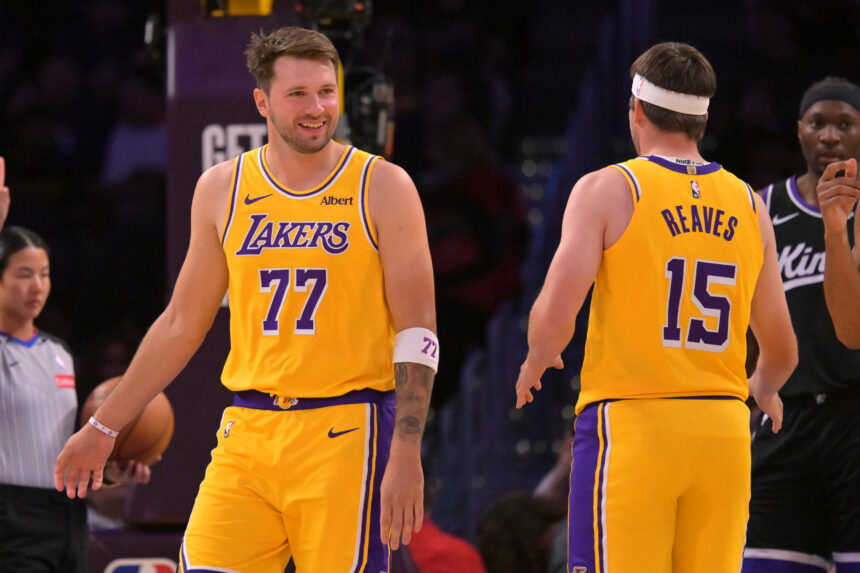
Austin Reaves believes the Los Angeles Lakers’ effort to take better care of the ball starts with him and Luka Doncic.
Speaking after Sunday’s practice, Reaves identified turnovers as one of the issues Los Angeles needs to address before the regular season. He included himself in the criticism while pointing to the responsibility shared by the team’s leading creators.
“I’m pretty sure JJ said that we had 20 or more turnovers in every game,” said Redick. “Me and Luka probably are the main catalyst for those. So clean those up.”
Reaves also called for better offensive organization and fewer defensive mistakes, describing a team that has emphasized intensity and now needs to become more precise.
His comments give the Lakers a specific task as they work through their preseason combinations. Creating opportunities is only part of the assignment for the players directing the offense.
They also have to help the group recognize when an advantage is available and when a possession needs to be reset.
The Lakers’ turnover problem extends beyond their two guards
The official NBA box scores show a consistent problem across the opening three exhibitions: Los Angeles committed 21 turnovers against Sacramento on Oct. 5, then 22 against Golden State the following night.
In Thursday’s 114-110 win over Sacramento, the Lakers had 24 turnovers. Doncic committed five and Reaves three; Reaves also delivered eight assists.
Those team totals add up to 67 turnovers, an average of 22.3 per game. The different lineups have produced the same broad warning: Los Angeles is ending too many possessions without making the defense deal with a shot.
The Thursday breakdown also adds necessary context to Reaves’ admission. He and Doncic accounted for eight of the team’s 24 turnovers, leaving two-thirds elsewhere.
Taking responsibility as a primary creator does not mean the entire problem belongs to those two players. Nor should their passing be judged solely by the mistakes.
Reaves’ eight assists illustrate the other side of that calculation. The goal is to preserve the chances he creates while reducing the possessions that produce nothing.
A raw turnover count cannot explain every failed possession, either. A misplaced pass, an offensive foul and a violation can all end an attack, but they require different corrections.
The Lakers need better execution across the group, not simply fewer ambitious passes from their best playmakers.
Better ball security would help the Lakers’ defense
Reaves’ answer connected offensive organization with defensive cleanup. He described some of the defensive confusion as a consequence of players applying effort without always staying coordinated, while emphasizing that playing hard had been an early priority.
That distinction matters for a roster experimenting with how to pressure opponents. Activity can disrupt an offense, but it can also create an opening if teammates do not recognize who is covering the space a defender leaves behind.
Redick has already discussed keeping zone defense among the Lakers’ options after testing it against Sacramento. Developing that coverage requires communication and positioning, two things that become harder when an opponent gets the ball before the defense is organized.
A live-ball turnover can force players to sprint back, identify an opponent and protect the basket simultaneously. Even an effective half-court scheme has limited value on a possession in which the defense never gets established.
The Lakers’ separate rebounding plan for minutes without Walker Kessler addresses another way possessions can get away from them. Offensive mistakes surrender opportunities at one end; missed defensive rebounds give opponents additional chances at the other.
Those problems should not be combined into a single statistic or assigned to one lineup without further evidence. They do, however, explain why improvements in possession management can matter even when a team is playing with energy.
Reaves wants other Lakers to keep making plays
Reducing turnovers does not require every possession to begin with Reaves or Doncic. In another Sunday comment, Reaves endorsed Sandro Mamukelashvili’s ability to initiate offense after collecting a rebound, even when either guard is on the court.
Reaves made clear that the guards are comfortable allowing Mamukelashvili to advance the ball and choose the next action.
“He's got such a high basketball IQ that if he gets the rebound, he should basically play the 1. And it doesn't matter if I'm on the floor, it doesn't matter if Luka's on the floor. If he gets it and goes … we trust whatever he has planned” – Austin Reaves on Mamukelashvili pic.twitter.com/TJWCe9BhLt
— Dave McMenamin (@mcten) October 11, 2026
“We trust whatever he has planned,” Reaves said.
That confidence offers an important qualification to the turnover discussion. The intended correction is not to remove initiative from everyone outside the starting backcourt.
A rebounder who can handle the ball can begin an attack before the defense has finished matching up. For the other four players, that opportunity creates responsibilities of its own.
They need to provide passing options, maintain spacing and recognize whether to keep moving or allow the ballhandler room to attack.
The same principle applies when Reaves or Doncic brings the ball forward. A successful decision depends partly on teammates arriving in useful positions.
Cutting out unnecessary mistakes is a collective task even when one player is ultimately charged with the turnover.
Redick is still evaluating how the pieces fit
The Lakers are also working through unsettled personnel choices. Asked Sunday about the remaining starting spots, Redick said that injuries had complicated the evaluation.
“We’ve certainly seen glimpses of the things we like. It's hard because we've just been a little disjointed with the guys being banged up, so there's nothing definitive yet.” – JJ Redick on determining the two Lakers opening night starters next to Doncic/Reaves/Kessler pic.twitter.com/NcX6ccSk2f
— Dave McMenamin (@mcten) October 11, 2026
“We’ve certainly seen glimpses of the things we like,” Redick said.
He stopped short of announcing a final decision. That leaves the team balancing two needs: giving combinations a chance to develop and establishing dependable habits that should carry across different groups.
For the turnover issue, the most useful next step is to examine which mistakes repeat. If the same action keeps ending in a misplaced pass or confused spacing, the problem is more specific than a general lack of chemistry.
A lower turnover total would be encouraging, but it should come alongside an offense that still creates worthwhile opportunities. Slowing every possession simply to avoid risk would not necessarily make the Lakers more effective.
Reaves has identified his own responsibility in finding that balance. The next test is whether Los Angeles can turn that accountability into possessions that remain purposeful from the first pass through the final decision.