
Arthur Kaluma was not supposed to start on Saturday night. He was not supposed to be in Las Vegas as anything more than a familiar developmental face, a returning G League forward getting one more extended look.
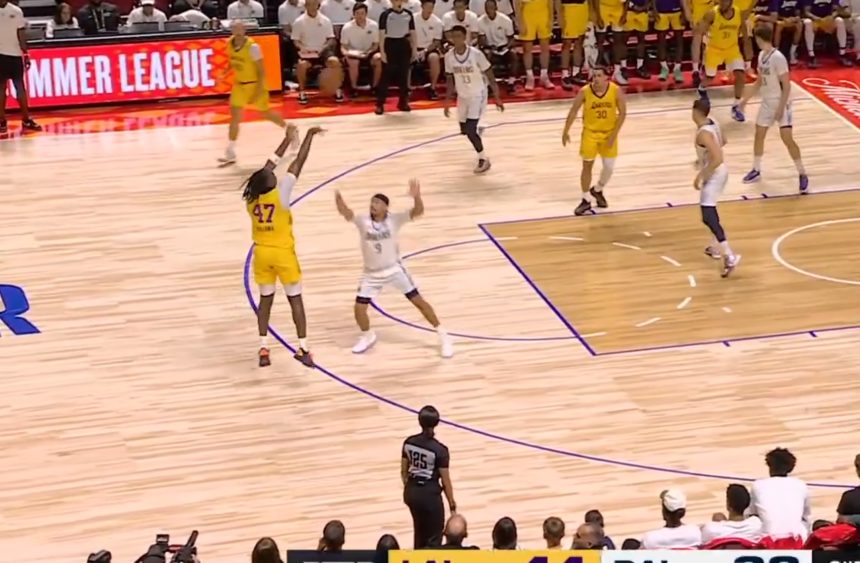
Instead, with Cameron Carr sidelined, Kaluma stepped into the Lakers’ starting lineup against the Dallas Mavericks and delivered the loudest individual performance of their summer: 34 points on 11-of-16 shooting with six 3-pointers in a 91-70 win, that pushed the Lakers to 2-0 in Vegas and 4-1 overall this summer.
Here is the part that should have Rob Pelinka’s attention: The player who just authored the highest-scoring game of the entire Summer League slate on Saturday, is not under contract with the Lakers or with anyone.
A career night from a career bench player
The Lakers’ second game in Las Vegas was billed as another checkpoint for Adou Thiero, who had electrified the Thomas & Mack Center in Friday’s win over the Thunder. Carr, the No. 24 pick, was ruled out with a right thumb contusion, which opened a starting spot for a player who, remarkably, had never started a professional game stateside — not once in 35 G League appearances for South Bay last season.
Kaluma treated the promotion like a debt coming due. He poured in 18 points on 6-of-8 shooting by halftime of a game that saw 13 lead changes and seven ties in the first two quarters, then helped Los Angeles pull away in a second half it controlled from start to finish.
HAVE A NIGHT, ARTHUR KALUMA!
34 PTS (11-16 FGM)
5 REB
6 3PMThe @Lakers pick up the win in @NBASummerLeague play 👏 pic.twitter.com/2rxcKFxVlJ
— NBA (@NBA) July 12, 2026
The Lakers led by as many as 27 while piling up a 42-24 advantage in points in the paint and a 30-14 edge in points off turnovers, Kaluma finished with five rebounds alongside the 34 points, went a perfect 3-of-3 from the free-throw line and hit 6-of-10 from deep. Five turnovers were the lone blemish on the night.
Lakers Summer League coach Ty Abbott didn’t bother tempering the moment.
When the Lakers ran designed actions for Kaluma, Abbott said, “He knocks them (shots) down and just plays out of his mind.”
The most efficient month of anyone in a Lakers uniform
The eruption against Dallas was not a one-night anomaly. It was the crest of a wave that has been building since the California Classic. Across four summer appearances, Kaluma is averaging 20.0 points and 4.2 rebounds per game in just 23.0 minutes, shooting 59.1 percent from the field, 38.1 percent from 3-point range and 86.7 percent from the line.
One night before torching Dallas, he didn’t miss at all. Kaluma went 5-of-5 from the field and 5-of-5 from the line for 18 points in 16 minutes against Oklahoma City, with zero turnovers.
Only three players scored more points in any game across Saturday’s eight-game Vegas slate than Kaluma has managed per shot attempt this month — the efficiency is that far removed from typical summer-league volume scoring.
The background makes the surge more credible, not less. Kaluma, 24, went undrafted out of Texas in 2025 and spent his rookie professional season with South Bay, where he averaged 14.6 points and 5.0 rebounds per game on 54.5 percent shooting across those 35 games, all off the bench.
This is not a stranger the Lakers unearthed in July. It’s a player their own developmental staff has had in the building for a full year, now converting that familiarity into production under brighter lights.
The Lakers don’t control what happens next
This is where the story stops being a feel-good summer note and becomes a front-office problem. The Lakers hold only Kaluma’s returning G League rights — he is not under an NBA contract, and nothing prevents him from signing a standard or two-way deal with any of the other 29 teams.
If another front office watching in Las Vegas decides it has seen enough, the Lakers would collect nothing in return. His current NBA status is listed as an unrestricted free agent.
Returning rights guarantee the Lakers one thing only — that if Kaluma plays in the G League next season without an NBA deal, it would be with the newly relocated Coachella Valley Lakers. They guarantee nothing about the NBA level, which is precisely where his play is now pointing.
Every additional 30-point night makes the status quo less stable, because Summer League is the most-scouted developmental showcase on the calendar, and Kaluma is currently one of the best stories in it. NBA.com named him a Day 3 standout alongside lottery-adjacent names like Labaron Philon, noting how fresh his legs looked running the floor and finishing through contact.
The two-way math
The obvious mechanism for keeping him is a two-way contract, and that’s where the roster squeeze gets real. All three of the Lakers’ two-way slots are occupied — by Chris Manon, AK Okereke and Peter Suder.
None of the three is locked in stone, but each case is different. Manon has been one of the steadier hands of the Lakers’ summer and drew praise from NBA.com’s broadcast coverage as a heady, physical guard.
Suder picked the right night to answer, scoring 14 points off the bench against Dallas in his best outing of the summer. Okereke has been the quietest of the trio, which makes his slot the one most likely to enter the conversation if the front office decides Kaluma’s surge demands action.
The squeeze extends up the roster sheet, too. The Lakers made Collin Sexton’s signing official on Sunday — a two-year, $19 million deal on the room exception first reported by ESPN’s Shams Charania when the sides agreed on July 1.
With Sexton in the fold behind Walker Kessler, Quentin Grimes and Sandro Mamukelashvili, the rebuilt 2026-27 roster is nearly set, and the spending power beyond minimum deals is gone. For a player in Kaluma’s position, the realistic path in Los Angeles runs through those three two-way slots — or through another team’s open checkbook.
A narrowing window
The Lakers are back on the floor Tuesday against the Clippers, with more Vegas basketball behind that. Under normal circumstances, that’s just more runway for a summer standout. In Kaluma’s case, every remaining game is also an open audition in front of 29 other front offices for a 24-year-old wing shooting nearly 60 percent for the month who costs nothing to acquire.
That is the tension the Lakers now have to price. Keeping the projected depth chart intact means betting that no one else moves first on a player their own system developed. Summer League performances can be mirages — the competition is uneven and the samples are small.
But 34-point mirages from players who shoot 59.1 percent for a month tend to get paid by somebody. The only question the Lakers control is whether that somebody is them.