
Editor’s update — July 3, 2026: The Lakers have traded Deandre Ayton to the Washington Wizards for guard Jaden Hardy and two second-round picks, removing Ayton from the depth chart below and reopening the backup center spot behind Walker Kessler. The projected starting five is unchanged; the reserve and roster-need sections have been updated to reflect the move.
The Los Angeles Lakers walked into the second day of free agency without a center and, in the span of roughly half an hour, walked out with a reshaped roster.
After acquiring Walker Kessler in a sign-and-trade and agreeing to deals with Quentin Grimes, Collin Sexton and Sandro Mamukelashvili, the front office has finally handed Luka Doncic a supporting cast built to his specifications. With their spending power now essentially exhausted, the shape of the 2026-27 team has come into focus.
Here is how the Lakers’ projected lineup and depth chart look once the dust of Wednesday morning settled, and where the roster still needs work before training camp opens.
The projected starting 5
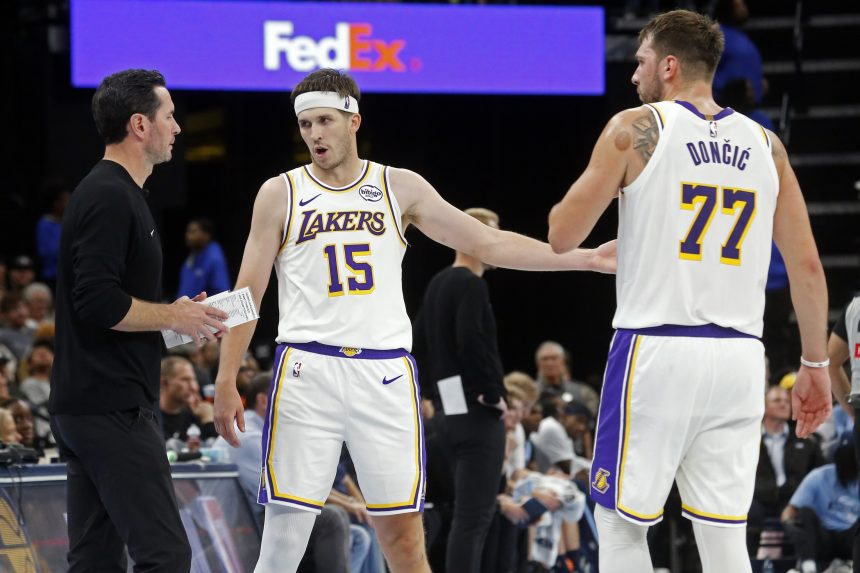
Barring another move, the Lakers’ opening-night starting group projects as Doncic, Austin Reaves, Grimes, Mamukelashvili and Kessler. It is a five built around the shot creation of Doncic and Reaves, with the three new additions plugging holes the roster could not cover a year ago.
Kessler is both the headliner and the fulcrum. The 7-foot-2 center gives Doncic the rolling, rim-protecting big he had asked the front office to find, a vertical lob threat on one end and a genuine paint deterrent on the other. He does not need touches to matter, which lets Doncic and Reaves run the offense without a third mouth to feed in the halfcourt.
Grimes slots in as the starting wing, a rangy guard who can defend on the perimeter and space the floor off the Lakers’ two primary creators. Mamukelashvili, added on a four-year deal, is a skilled, shooting-capable big who can play the 4 next to Kessler and slide up to backup center in smaller looks. Together, the two newcomers give head coach J.J. Redick lineup flexibility across the frontcourt that last year’s roster simply did not have.
The bench and the depth chart
Sexton headlines a reserve group that also includes Jake LaRavia, Jarred Vanderbilt and Jaden Hardy — the young guard acquired in the Ayton trade — with young players Adou Thiero, Cameron Carr, Bronny James and Dalton Knecht rounding out the roster.
Sexton, signed to a two-year deal, gives the second unit a downhill scorer and shot-maker who can carry bench minutes when Doncic sits, addressing a need created by the departures of Marcus Smart and Luke Kennard. That group no longer includes a true backup center, however. The Lakers traded Deandre Ayton — long ticketed for the reserve role behind Kessler — to the Washington Wizards on Friday and are now searching the veteran market for a replacement.
Jonas Valanciunas and Kevon Looney are among the names the Lakers have weighed, sources told ESPN’s Shams Charania, though the market is thinning quickly — Andre Drummond, another center the Lakers had considered, agreed to a deal with the New York Knicks later Friday. Hardy, a 23-year-old guard and former teammate of Doncic in Dallas, may prove more useful as a movable $6 million contract than a rotation lock. Vanderbilt brings defensive energy across the forward spots, while Thiero and Carr are the developmental swings the Lakers are counting on to grow into rotation minutes.
The bench has scoring and size, but its playoff-caliber depth is thinner than the top of the roster suggests, which becomes clearer when the money is laid out.
The money, at a glance
The Lakers committed serious long-term salary to remake the roster in a single morning. Kessler’s four-year, $130 million deal is the centerpiece, followed by Grimes at four years and $60 million and Mamukelashvili at four years and $52 million, each carrying a player option, with Sexton added at two years and $19 million, according to ESPN’s Shams Charania.
The Sexton signing effectively spent the last of the Lakers’ flexibility. From here, the front office can add only veteran-minimum contracts or reshape the roster through a trade, which frames every remaining decision this offseason. Any further upgrade will have to come cheaply or by moving a piece already on the books.
Friday’s Ayton trade nudged that math back in the Lakers’ favor. Swapping Ayton’s $8.1 million salary for Jaden Hardy’s $6 million trimmed roughly $2 million off the books and brought back two second-round picks, handing the front office fresh trade capital. It is not a windfall, but it is the room and the assets to chase one more move.
Where the roster is still thin
For all the activity, the Lakers did not close every gap, and the most obvious one is on the wing. The roster lacks a true stopper for the elite 6-foot-6 to 6-foot-9 scorers who define the Western Conference’s best teams, and neither Grimes nor Sexton profiles as the kind of point-of-attack defender who can slow a top guard across a seven-game series. The Lakers landed their defensive anchor in Kessler, but their perimeter defense remains a real question against the rosters they will have to beat in the spring.
Depth behind Kessler is the other concern, and it grew more acute with the Ayton trade. Kessler’s durability is not a given after he appeared in just five games last season before undergoing surgery to repair a torn labrum in his left shoulder, and the Lakers no longer have a proven veteran behind him after shipping Ayton to Washington.
Filling that backup center spot now sits near the top of the offseason to-do list. The Lakers have long used their brand as a landing spot for veterans willing to sign for the minimum, and that is the likeliest path to adding both a backup big and the wing defender the roster still lacks.
None of that changes the direction of the roster. It simply defines the to-do list, and it is why the Lakers still look like a team with at least one or two moves left to make.
The bottom line
What the Lakers have, in the opening days of the post-LeBron era, is a coherent roster built around Doncic rather than a collection of names stitched together at the last minute. The starting 5 fits, the salary is committed and the center problem that shadowed the franchise all season is finally solved. Whether a minimum-deal wing or a midsummer trade can turn a well-constructed roster into a genuine contender is the question that will carry the Lakers through the rest of the offseason.