
The Arthur Kaluma signing came with a bill, and on Tuesday, the Lakers paid it.
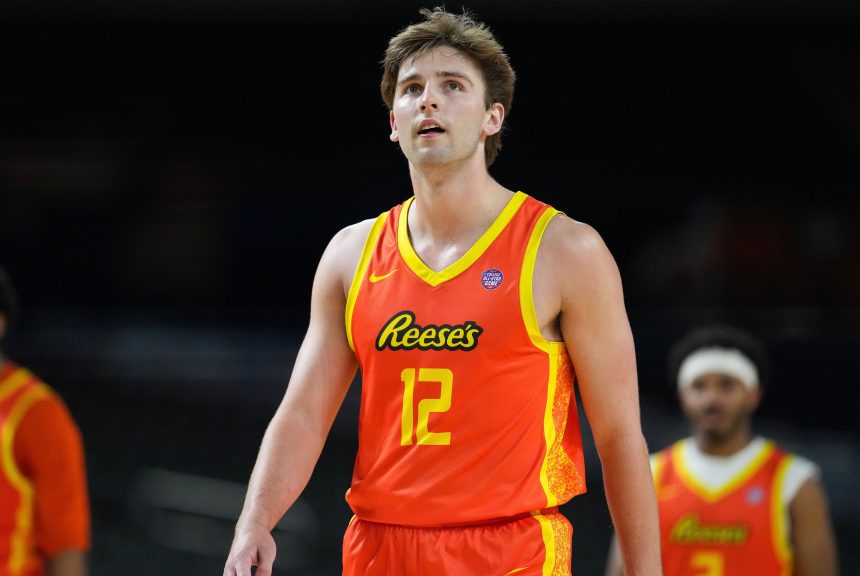
Los Angeles has waived rookie guard Peter Suder from his two-way contract, clearing the roster spot needed to finalize Kaluma’s two-way deal once Summer League wraps.
The Coachella Valley Lakers “would welcome Peter Suder to their roster,” a source told ESPN, but the organization understands he intends to weigh opportunities elsewhere first.
The move closes the loop on a decision that had been building all week. ESPN’s Shams Charania reported Monday night that the Lakers were signing Kaluma to a two-way contract after a Las Vegas run in which he averaged nearly 19 points per game while shooting 61 percent from the field and 50 percent from three.
With Chris Manon, AK Okereke and Suder occupying all three two-way slots, somebody had to go, and the front office’s choice was the least surprising one available.
The warning sign came Saturday
Anyone looking for a tell got one in the semifinal loss to Golden State. Suder never checked into that game, and The Athletic’s Dan Woike noted afterward that the rookie was healthy and available — the coaching staff simply chose not to use him.
For a player already holding an NBA contract on a summer roster full of hopefuls who don’t, a healthy scratch in the final game is about as loud as a benching gets.
That 92-88 defeat ended a strong Lakers summer, as they were 4-1 in Las Vegas and 6-2 overall counting the California Classic. First-round pick Cameron Carr and second-year forward Adou Thiero drew most of the developmental praise, Manon reinforced his standing and Kaluma turned himself into the story of the trip.
Suder was the one member of the two-way group moving in the other direction, and by Saturday night, the organization was no longer hiding it.
A three-week rise and fall
What makes the outcome striking is how quickly it arrived. Suder signed his two-way contract with the Lakers immediately after going undrafted out of Miami (Ohio) in June — a deal in hand before he had played a single professional game. Less than a month later, that same contract is gone.
The pedigree that earned the deal was real. Suder was named MAC Player of the Year as a senior, after a season in which he put up 14.8 points, 4.6 rebounds, 4.0 assists and 1.3 steals per game on 54.6 percent shooting overall and 42.1 percent from deep. Those are numbers that get an undrafted guard signed within hours, and they did.
The summer, though, never cooperated. Across six appearances between the California Classic and Las Vegas, the 22-year-old averaged 5.3 points, 3.2 rebounds and 1.7 assists in 17.5 minutes per game while shooting 33.3 percent from the field and 22.2 percent from three.
He also committed 2.0 turnovers per game against just 1.7 assists’ worth of playmaking value, a rough ratio for a guard trying to prove he can run second units. There was one night that showed what the Lakers thought they were signing.
In the July 11 win over Dallas — the same game Kaluma detonated for 34 — Suder came off the bench for 14 points in under 17 minutes, hitting 5-of-8 from the field with a pair of threes. He scored five points or fewer in four of his other five outings, and the flash in Dallas ended up reading less like a breakthrough than an outlier.
Why the spot went to Kaluma
The other side of this transaction was covered in depth here when Kaluma’s surge first forced the roster question, and the logic laid out then is exactly the logic that played out this week.
The Lakers held only Kaluma’s returning G League rights, which meant any team in the league could have signed him away for nothing. Once he finished Vegas as one of the most productive unsigned players on the circuit, waiting around stopped being an option.
It also was never likely to be Manon or Okereke who made way. Manon kept stacking the physical perimeter defense that made his name with South Bay, while Okereke — the undrafted Vanderbilt forward Los Angeles moved on right after the second round of June’s draft — earned positive marks from the coaching staff for his defense and corner shooting.
Suder was the two-way player with the weakest summer resume, and roster math at this level is rarely more sentimental than that.
With the standard roster already at 15 following the Ziaire Williams signing, the two-way tier was the only place this squeeze could resolve. The rebuilt 2026-27 roster is effectively set, which is precisely why the margins battles are being fought three contracts below the luxury-tax line.
What comes next for Suder
The most interesting part of Dave McMenamin’s report is the part about what the Lakers still want. Coachella Valley — the organization’s G League affiliate — has an open door for Suder, but he and his camp plan to survey the market before walking through it.
That is the rational play for a 22-year-old with a conference player of the year award on his resume, because 29 other front offices watched the same tape the Lakers did, and two-way rosters around the league are still being shuffled through August and September.
If no two-way offer materializes elsewhere, the familiar path back is easy to sketch, though it should be treated as a possibility rather than anything reported: an Exhibit 10 deal for training camp, a preseason audition and then a season in Coachella Valley with the affiliate that just told ESPN it wants him.
That is the exact route Kaluma took a year ago — Exhibit 10, waived before opening night, a full G League season, then a summer that earned him the contract Suder just lost. The Lakers’ developmental pipeline has now produced its first true roster collision, and the player it squeezed out may end up betting on the same machine that cut him.
For the front office, the calculus was cold but defensible. For Suder, the next month will determine whether Tuesday was a setback or just a detour, and the franchise that waived him is openly hoping the answer runs through the desert.