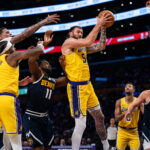

The Los Angeles Lakers made a trade Friday that, judged only by the names in it, barely registers: veteran center Deandre Ayton to the Washington Wizards for guard Jaden Hardy and two future second-round picks, in 2031 and 2032, according to ESPN’s Shams Charania.
Ayton was a rotation piece the front office had already decided to move past. Hardy is a 23-year-old guard who lands on a deep depth chart. On its own, it reads like a footnote to a busy week.
It is not really about either player, though. Strip the deal down and it is a flexibility play — a few million dollars in savings and a pair of tradable picks handed to a front office that had almost nothing left to work with. The Ayton trade is not the move. It is the move that makes the next one possible.
The money the trade actually freed up
Here the numbers matter more than the names. Ayton was set to earn $8.1 million this season after picking up his player option earlier in the week. Hardy carries a $6 million salary with a team option for 2027-28, so swapping one for the other trims roughly $2 million off the books. Marc Stein of The Stein Line described the return as about “$2 million in financial wiggle room” for the Lakers’ summer business.
Two million dollars does not sound like much, and on its own it is not. What gives it weight is everything the Lakers had already spent to get here. Landing Walker Kessler in a sign-and-trade with the Utah Jazz cost a four-year, $130 million commitment plus two future first-round picks and two future pick swaps — a haul that left the draft cupboard nearly bare. The two second-rounders coming back from Washington begin to restock exactly what the Kessler deal drained.
That is the quiet value of this trade. It does not open a war chest, but it hands Rob Pelinka a little more room under the cap and, more importantly, fresh chips to package in a deal. Both are prerequisites for the move the Lakers actually still need to make.
Jarred Vanderbilt is the domino everyone is watching
If the Ayton trade is the setup, Jarred Vanderbilt is the most likely payoff. His $12.4 million cap hit is the single biggest obstacle to the Lakers adding anyone of consequence on the open market, and the front office has a decision to make on it.
There are two paths, and the newly acquired picks make one of them easier. The Lakers can attach those second-rounders to Vanderbilt’s contract as a sweetener and find a team willing to take him in a straight salary-dump trade, which is the cleaner outcome. The alternative is to waive-and-stretch him, spreading the remaining money across five seasons and freeing up roughly $7.3 million in spending power while leaving a dead-cap charge on the books each year.
Neither is glamorous, but both point at the same conclusion: The Lakers are not finished, and clearing Vanderbilt’s number is the mechanism that unlocks whatever comes next. The picks from Washington are the grease for precisely that kind of transaction, which is why the return in this trade was structured around assets rather than a rotation upgrade.
What the room is being cleared for
The Lakers have been fairly transparent about the shopping list. Stein reported that in the wake of the Ayton deal, Los Angeles is “pursuing both a wing defender and a backup big man.” Kessler needs a backup now that Ayton is gone, and Charania named Andre Drummond, Jonas Valanciunas and Kevon Looney as veterans the Lakers are weighing on the open market, all of whom would come cheaper than Ayton and slot more naturally into a reserve role.
The wing is the harder itch to scratch, because the best options cost real money the Lakers do not yet have. Rui Hachimura remains unsigned, and Jonathan Kuminga has been among the names Los Angeles has explored, but landing either almost certainly requires clearing salary first. That is the throughline connecting every one of these threads back to Vanderbilt: The Lakers cannot meaningfully add until they subtract, and the Ayton trade was the first subtraction.
The player the Lakers moved on from
For all that the deal is about mechanics, it does close the book on a genuine experiment. Ayton arrived last summer after a buyout from the Portland Trail Blazers and started all 72 games he played, averaging 12.5 points, 8.0 rebounds and 1.0 block per game on 67.1 percent shooting. The efficiency was never the problem.
The fit was. Los Angeles had promised Luka Doncic a rolling, rim-running, lob-catching center, and Ayton was not that archetype. His postseason underscored the split — a strong first-round series against the Houston Rockets, where he averaged 11.8 points and 10.8 rebounds per game, followed by a quiet second-round sweep at the hands of the Oklahoma City Thunder, where his production dipped to 7.3 points and 7.8 rebounds per game. Once the Lakers landed a center who fit Doncic’s game, keeping Ayton as an expensive backup made little sense.
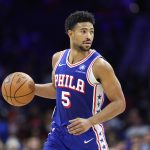
Hardy, the guard coming back, is a useful young scorer with a narrow path to minutes. A former teammate of Doncic in Dallas, he averaged 12.6 points, 1.7 rebounds and 1.3 assists per game on 44.3 percent shooting, including 42 percent from 3-point range, across 23 games with Washington last season, per ESPN. In a backcourt already featuring Doncic, Austin Reaves, Collin Sexton and Quentin Grimes, his value to the Lakers may ultimately be as a movable $6 million contract rather than a rotation fixture.
The bottom line
All of this is unfolding in the first days of the post-LeBron era. LeBron James informed the team earlier this week that he intends to continue his career elsewhere, ending an eight-year run and reorienting the roster fully around Doncic. Every move Pelinka makes now is aimed at building Doncic’s team, and the Reaves max extension plus the Kessler, Grimes and Sandro Mamukelashvili deals had already spent nearly all of the summer’s flexibility.
Seen that way, the Ayton trade is not the ending it looks like on the transaction wire. It is a table-setter — a redundant salary swapped for a cheaper, movable one, a bare draft cupboard partly restocked, and a clear runway toward one more addition. Whether that runway ends in a wing stopper, a backup center or both will decide how this offseason is judged. On its own, the Ayton move is smart housekeeping. Its real grade will not be written until the next domino falls.