
Austin Reaves was somewhere in the middle of a golf round in Stateline, Nev., playing the American Century Championship, when the shape of the rest of his career changed.
Word reached him that LeBron James had informed the Lakers he would not return for a 24th NBA season, closing a five-year partnership that has spanned nearly all of Reaves’ professional life.
His first instinct was his phone. Reaves said he texted James to tell him he “was having a great day on the golf course until he ruined it,” speaking Wednesday with Edward Lewis of the California Post. It was a joke, and Reaves clearly meant it as one.
He said almost immediately afterward that the ribbing carried no bitterness, that he cannot fully articulate what James has meant to him, and that he expects to see his former teammate on a course in Los Angeles before long.
But the joke has an edge to it that Reaves probably did not intend, because the Lakers did not simply lose a friend when James announced on June 30 that he would play somewhere else in 2026-27. They lost the one thing this roster was never built to replace.
What Reaves is losing
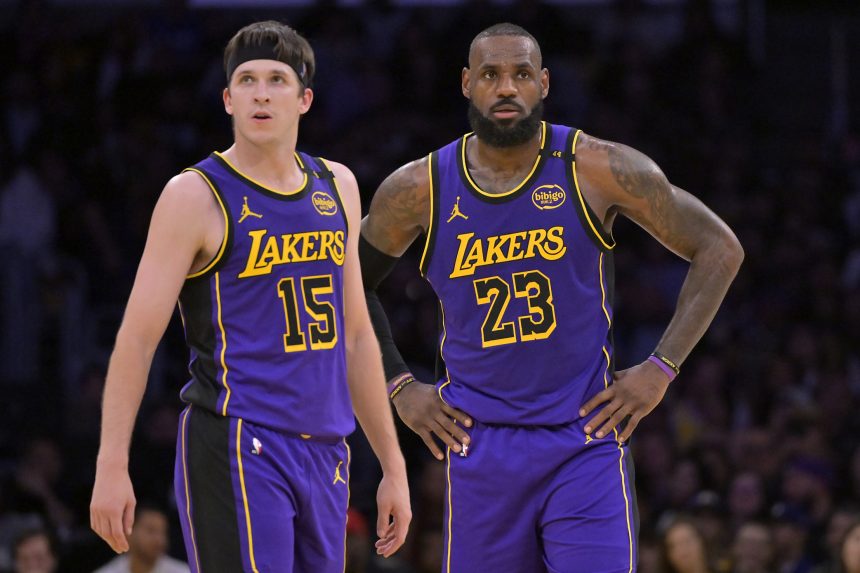
Reaves arrived in Los Angeles in 2021 as an undrafted free agent, and James spotted him before almost anyone else did. He vouched for the guard internally, pushed for him to play, and by the end of the partnership the two were the most tenured players on the roster. Reaves, now 28, has never spent an NBA season without James on his team.
That is the sentimental version. The practical version is harder. Reaves is coming off the best year of his career — 23.3 points, 4.7 rebounds and 5.5 assists per game on 49.0 percent shooting and 36.0 percent from 3, — but he played only 51 games while dealing with calf and oblique injuries, a career low.
He was excellent when he came back. In six playoff appearances he averaged 20.0 points and 5.8 assists per game before Oklahoma City eliminated the Lakers in the second round. What made that survivable was that Los Angeles had a third option capable of running an offense by himself whenever Reaves or Luka Doncic could not.
The $185 million deal that still isn’t signed
The contract everyone assumes is finished technically is not, and the reason why explains the entire rest of the Lakers’ summer.
Reaves intends to sign a four-year, $185 million maximum deal with a player option in the final year, ESPN’s Shams Charania reported on June 24. He declined a $14.9 million player option to make it possible. It is the largest contract an undrafted player has ever signed, and it pays him $41.3 million in year one.
Buried in that same report is the sentence that matters most. Because Reaves’ cap hold sits at $20.9 million — far below what he will actually earn — the Lakers deliberately structured the offseason so that he would put pen to paper only after every other dollar had been committed. He signs last, by design.
Rob Pelinka was unambiguous about wanting him back, saying at exit interviews that the front office wanted “his odyssey to continue to unfold in the Purple and Gold.” Nobody disputes the priority. The mechanism, though, means the Lakers spent this offseason working with a temporary and artificially inflated amount of room, and every dollar of it is now gone.
The playmaking hole nobody has filled
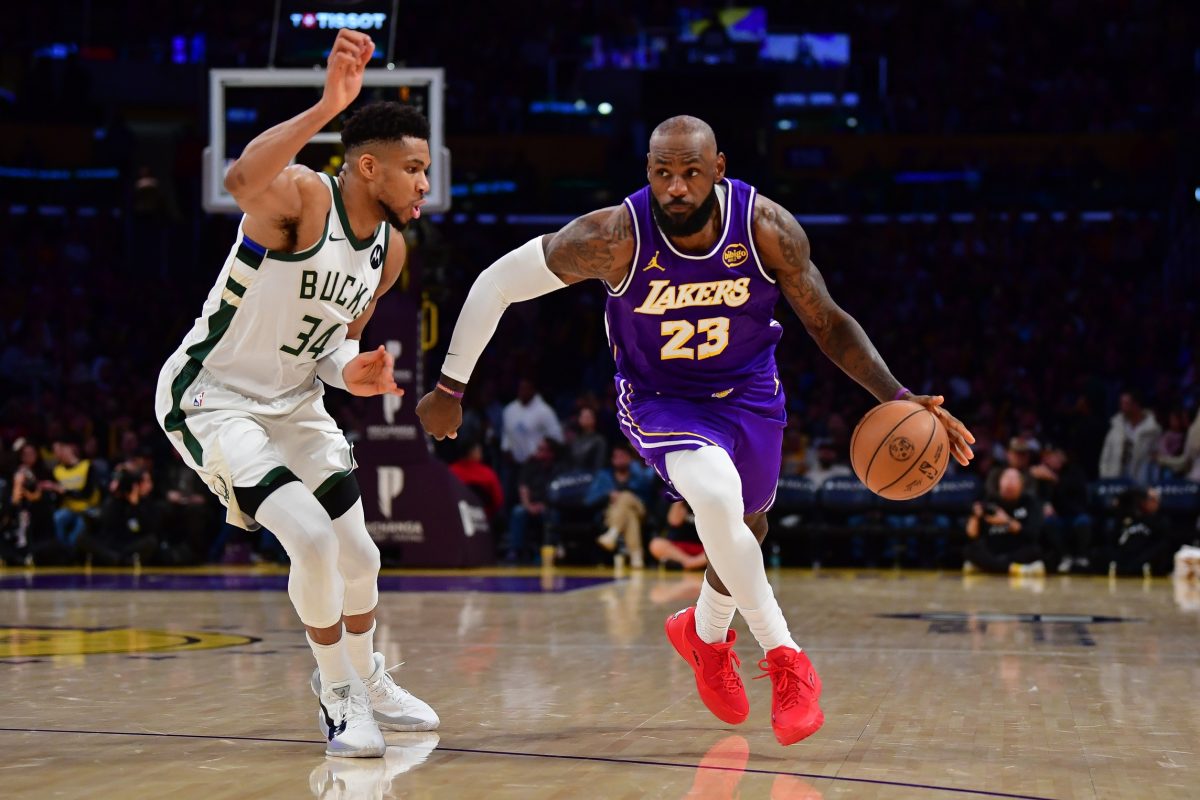
Here is the part that has gone almost entirely unexamined in the wave of coverage this week.
James turned 41 last December and still finished seventh in the NBA in assists per game, averaging 20.9 points, 6.1 rebounds and 7.2 assists per game across 60 appearances.
He was not the leading scorer on a 53-win team, and by that measure his departure looks absorbable. He was, however, the only player on the roster besides Doncic who could reliably create a shot for someone else out of nothing.
Now look at what the Lakers actually added with their cap space. Walker Kessler is a rim-running center. Sandro Mamukelashvili is a stretch big. Quentin Grimes and Collin Sexton are perimeter scorers.
Every one of those additions is a beneficiary of creation, not a source of it. Not a single one profiles as a primary initiator.
That leaves Doncic and Reaves as the entire offensive engine, and the availability math is the uncomfortable part. Reaves played 51 games last season. James played 60.
When one of the Lakers’ two guards went down — which happened repeatedly — James slid back into the role he had occupied for two decades and kept the offense functional. That safety net has been removed from a team whose two remaining creators have both missed significant time in the past year.
The scoring can be replaced. The 7.2 assists per game, and the ability to generate them when the other two options are in street clothes, cannot be replaced by anyone currently under contract.
Why the wing search got harder
This is where Reaves’ contract structure stops being a technicality and starts being a constraint.
The Lakers used the majority of their financial flexibility to secure Kessler, Mamukelashvili, Grimes and Sexton, leaving very little for an offer to Jonathan Kuminga. Pelinka and JJ Redick had pitched Kuminga virtually on June 30, the day after Atlanta declined his $24.3 million team option, selling him on heavy minutes as a wing next to Doncic.
The pitch worked, but the money did not. Pelinka has stayed in contact with Kuminga’s agent, Aaron Turner, quietly improving the offer, while Kuminga’s camp holds out for better structures as the market’s remaining dominoes fall.
Sacramento would need a sign-and-trade it has been reluctant to discuss. Cleveland has real interest, given Kuminga’s history with coach Kenny Atkinson, but the Cavaliers are frozen while they wait on LeBron James’ free agency decision.
Which leaves Atlanta, and a framework: The Hawks are open to a sign-and-trade that would help Kuminga preserve his Bird rights, though general manager Onsi Saleh would have to be paid to do it. Los Angeles has Jarred Vanderbilt, Dalton Knecht and Jaden Hardy to send out, plus three second-round picks and a 2032 first-round pick swap.
That is the trade package Atlanta is reportedly asking for, and it is the only realistic path to a starting-caliber forward.
None of that is a cap-space problem the Lakers can solve by clearing a contract. It is a trade-matching problem, and it exists because Reaves’ max is waiting at the back of the line.
The longest-tenured Laker
Reaves has been in purple and gold since the 2021-22 season, which makes him, as of this week, the longest-tenured player on the roster. James is gone. Rui Hachimura signed with the Clippers. Deandre Ayton was traded to Washington.
The 2026-27 group is a nearly complete rebuild around Doncic, and the guard who joined it as an undrafted afterthought is now its institutional memory.
Reaves will begin his sixth NBA season without the teammate who talked the coaching staff into playing him. He will do it as the second-highest-paid player on a team that has committed to him for four more years, on a roster where Grimes and Redick already have history and almost nobody else has any at all.
He is not wrong that James ruined his afternoon. What the Lakers have not yet worked out is who is going to make the pass.