
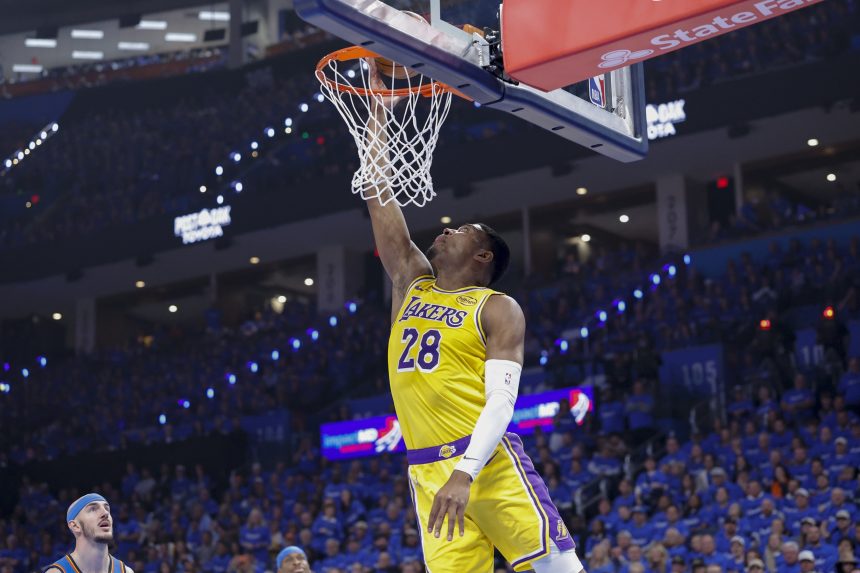
Rui Hachimura is staying in Los Angeles, just not with the Lakers.
The 28-year-old forward agreed Monday to a two-year, $28 million contract with the Clippers, ESPN’s Shams Charania reported, on the afternoon the league’s moratorium lifted and deals across the NBA became official. The second season carries a team option.
The move ends a three-and-a-half-year run in purple and gold, and it lands with an extra sting for two reasons that have little to do with the Clippers. The Lakers had a route to recoup value for Hachimura and did not take it, and they let him walk on a player their franchise cornerstone wanted to keep.
The sign-and-trade the Lakers wouldn’t finish
There was a version of this that returned something to Los Angeles. According to Charania’s reporting, Hachimura and his representation reached an understanding with the Clippers early in free agency, then waited while the Lakers worked through the rest of their offseason, with the idea of circling back to route the departure through a sign-and-trade.
That deal never came together. The two front offices did talk, per ESPN, but the conversation stalled over the size of the return. The Lakers wanted a draft pick coming back, while the Clippers were willing to part with little more than cash, and in the end, per a source close to Hachimura, the Lakers “didn’t cooperate on one.” The Clippers simply signed him outright.
Set that beside the rest of the Lakers’ week and the choice stands out. When the front office moved Deandre Ayton to Washington on Friday, it brought back guard Jaden Hardy and two second-round picks.
Hachimura, a more productive player than Ayton by most measures last season, produced no return at all. For a team short on draft capital after its summer of spending, that is capital left on the table.
Luka wanted him back
The decision looks sharper still against what Doncic reportedly wanted. Law Murray of The Athletic posted Monday that “Rui Hachimura was on the Luka Doncic preferred return list,” adding that the “Lakers wanted more defenders” and that the “Clippers had the cap space Lakers didn’t have,” per Murray’s report on X. Hachimura, Murray noted, wanted to stay in Los Angeles regardless of jersey.
The cap squeeze Murray referenced traces directly to the Lakers’ other moves. The Lakers were unable to match the Clippers’ offer after prioritizing Walker Kessler, Sandro Mamukelashvili and Quentin Grimes. Having committed their spending to that group, the Lakers no longer had a competitive number to keep a player their point guard had flagged to bring back.
None of that means the front office acted carelessly. The Kessler acquisition was a deliberate swing at the defensive backbone a Doncic-Reaves backcourt needs, and the “Lakers wanted more defenders” note fits that priority. But the sequence produced a specific outcome: a Doncic-endorsed rotation piece leaving for nothing, with the franchise pointed toward defense and away from a reunion its star preferred.
What the Lakers are losing
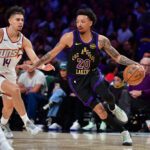
Whatever the cap logic, the on-court subtraction is real. Hachimura leaves as arguably the most productive Laker of last season’s playoff run. He averaged 17.5 points and 4.0 rebounds per game in the postseason while shooting 54.9 percent from the field, and his 56.9 percent mark from 3-point range led all players who averaged at least five attempts per game in the 2026 playoffs.
The regular-season profile was steady in the way a Doncic offense tends to reward. Hachimura scored 11.5 points per game across 68 appearances while shooting 51.4 percent from the field and 44.3 percent from 3-point range. A high-efficiency forward who spaces the floor and finishes plays without needing the ball is a clean fit next to a high-usage playmaker, which is a large part of why Doncic reportedly wanted him kept.
Replacing that shooting and that fit is now the task, and the market for it does not get easier from here.
Where this leaves the wing
The front office has not been idle at the position. Since James announced his exit, the Lakers re-signed Austin Reaves, landed Kessler in a four-year, $130 million sign-and-trade and added Grimes, Collin Sexton, Mamukelashvili and Hardy. What that group does not yet include is a like-for-like replacement for Hachimura’s wing scoring.
That gap is why Jonathan Kuminga has sat at the top of the Lakers’ board for the last meaningful roster spot. Monday’s signing removes the fallback behind that pursuit — if the Kuminga chase stalls, the Lakers no longer have a familiar in-house name to circle back to.
They also should not expect the Clippers to stop shopping the same aisle. Jake Fischer of The Stein Line reported that the Hachimura signing does not rule out a Clippers sign-and-trade pursuit of Nuggets restricted free agent Peyton Watson. The crosstown rival that just added a Lakers starter may not be done.
For now, the accounting reads plainly. Hachimura got the city he wanted and a raise structure paying him $14 million per year. The Clippers got a proven playoff shooter for the price of their mid-level exception.
And the Lakers, having chosen cap flexibility and defense over a return package and a reunion Doncic wanted, are left to prove the plan was worth it. Whether it was will depend entirely on the move they make next.