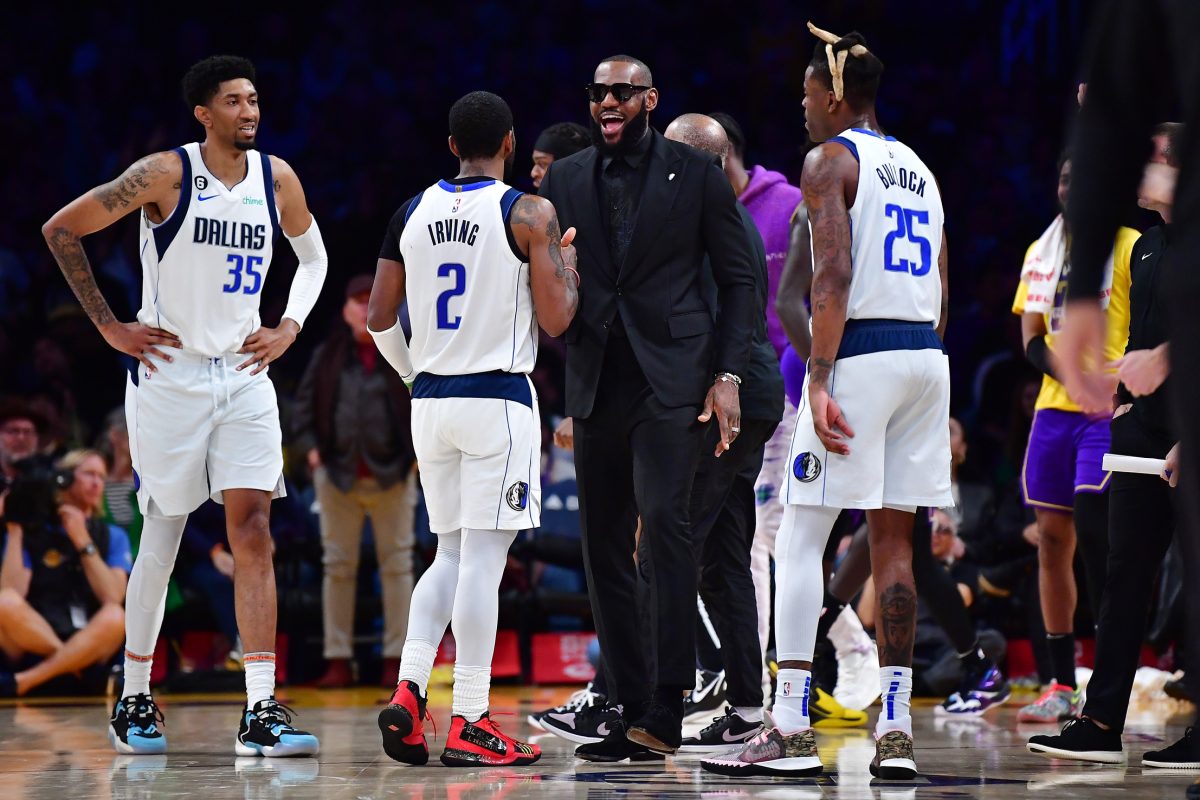

The Los Angeles Lakers are still looking for a trade as the deadline to finalize their opening roster approaches.
NBA insider Jake Fischer reported Wednesday that Los Angeles is among the teams pursuing deals, providing a fresh update on a roster decision that has followed the Lakers throughout training camp.
“Have heard the Bucks, Lakers and Grizzlies all exploring trades,” Fischer wrote.
The Clippers waiving Cam Christie leaves Charlotte, Milwaukee, Memphis and the Lakers as the most pertinent back-of-roster situations NBA personnel are monitoring before Oct. 19. Have heard the Bucks, Lakers and Grizzlies all exploring trades. Hornets have to weigh the locker…
— Jake Fischer (@JakeLFischer) October 14, 2026
The NBA’s roster deadline is Monday, Oct. 19, at 5 p.m. ET.
For the Lakers, the immediate issue is finding a way to reduce a group that entered camp with 16 guaranteed contracts. Rob Pelinka previously identified a consolidation trade as one possible solution, allowing Los Angeles to send out more players than it receives.
Fischer’s update does not identify a Lakers trade target, name an outgoing player or establish that an agreement is imminent. It does indicate that the trade route remains under consideration as the evaluation period nears its end.
Rob Pelinka already outlined a possible Lakers trade
Pelinka discussed the roster imbalance during his Sept. 24 media availability, when he described camp competition and potential transactions as parallel parts of the process.
As Lakers Daily covered at the time, the front office was leaving room for players to establish their standing before deciding how to reach the regular-season limit.
Pelinka also described the structure of a possible deal.
“There’s also consolidation trades that can still be looked at, trading two guys out, bringing one in,” Pelinka said.
That would address the roster count while giving the Lakers a chance to change the mix of players available to coach JJ Redick. Whether it would improve the team would depend on the return and the roles of the players leaving.
A two-for-one transaction would bring a 16-player group to 15. A straight one-for-one swap would leave another move necessary, even if the incoming player were a better basketball fit.
Pelinka’s September comments established a possibility. Fischer’s Wednesday reporting is the new development: Los Angeles is still exploring the market rather than having ruled out a deal during camp.
Dalton Knecht’s situation remains part of the backdrop
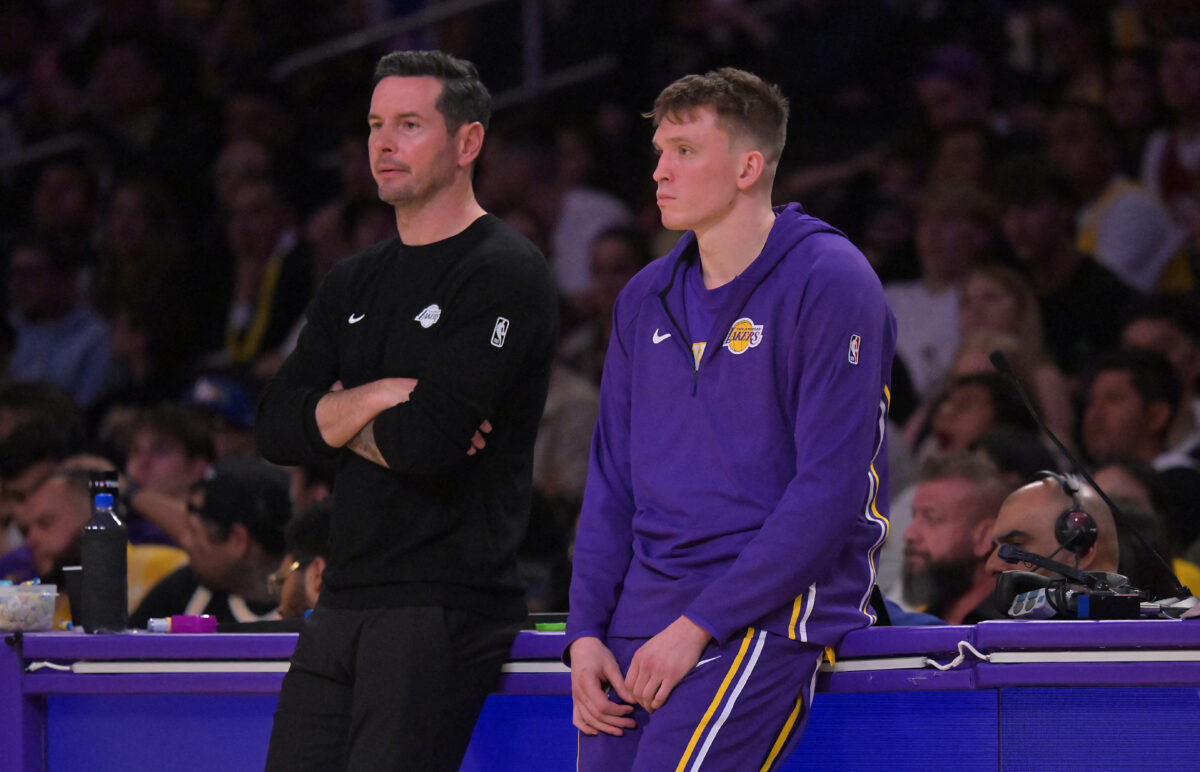
The uncertainty has been especially relevant for Dalton Knecht, although Fischer’s latest update does not specifically connect him to a proposed transaction.
In an Oct. 1 report, Khobi Price of The California Post wrote that multiple executives with other teams expected Knecht to be the player left out when Los Angeles reduced its standard-contract roster.
That was an assessment from outside the organization, not an announcement that the Lakers had decided to waive him. It also preceded Wednesday’s trade update and should not be treated as a newly reported decision.
Price described competition from a wing group that includes Quentin Grimes, Matisse Thybulle, Ziaire Williams, Adou Thiero and Cameron Carr. Redick, meanwhile, praised Knecht’s preparation and approach during the opening days of camp.
“I know he’s hungry to play and hungry to earn a spot in the rotation,” Redick said.
The distinction between making the team and earning regular minutes matters here. A player can remain under contract while sitting outside the preferred rotation, and a trade could alter both competitions at once.
The Lakers have basketball questions beyond the roster count
Redick’s recent comments also show why the front office’s evaluation cannot be reduced to choosing a name to remove.
Following Tuesday’s loss to Golden State, Redick pointed to rebounding as a continuing problem when Walker Kessler was unavailable on the floor. He emphasized that the responsibility extends beyond the starting center.
“We’ve got to do a better job of rebounding in general, whether he’s on the floor or not,” Redick said.
Redick also described difficulty organizing the offense in minutes without Austin Reaves and Luka Doncic while Collin Sexton was unavailable.
Those observations identify areas requiring improvement, but they do not establish which position the Lakers are targeting in trade talks.
Earlier, Redick had discussed using bigger wings in lineups without Kessler. That offers an internal adjustment to test alongside any potential personnel change.
For a prospective acquisition, the useful question would be whether he helps solve an identified problem without weakening another part of the rotation.
Simply exchanging two players for one would satisfy the arithmetic, but the basketball value would still need to justify the deal.
Why waiving a player is a different decision
A trade is not the only way to reduce the roster, and the financial consequences of a cut differ from the head-count consequences.
The NBA’s collective bargaining guide explains that salary still owed to waived players remains part of team salary, subject to adjustments. Removing someone from the roster therefore does not automatically eliminate the associated salary obligation.
The guide also distinguishes standard contracts from two-way deals. Teams generally carry 14 or 15 standard-contract players during the regular season, with up to three additional two-way players.
Sending a player on a standard contract to the G League does not solve an excess-roster problem, either: He remains on his NBA team’s roster while assigned.
Those rules help explain why the Lakers would investigate a trade before settling on a cut. The available return, any cost required to complete a transaction and the value of retaining particular players all affect that choice.
Fischer’s report leaves the outcome open. The Lakers have a roster decision to make, and their search for a trade is still part of that process.