
On paper, the Los Angeles Lakers’ offseason should be over. They spent their way through more than $50 million in cap space, exhausted the room mid-level exception on Collin Sexton and filled out the back of the roster with veteran-minimum contracts.
Then Jovan Buha said otherwise on Friday. “Well-positioned to add a starter now and still access the non-taxpayer MLE,” is how Buha described the Lakers’ situation, pointing to next summer’s mid-level as the second half of the equation.
The Lakers are well-positioned to add a starter now and still access the non-taxpayer MLE next summer. pic.twitter.com/fosOkAcBDR
— Jovan Buha (@jovanbuha) July 31, 2026
The claim landed hours after his latest mailbag, which walked through how the front office could add a wing or forward without sacrificing its 2027 flexibility.
That combination — a meaningful addition now and a preserved spending tool later — sounds impossible for a team in the Lakers’ cap position. It isn’t, and understanding why requires walking through the three constraints Rob Pelinka’s front office is operating under, because the path runs directly through them.
The hard cap that defines everything
Start with the constraint that shapes all the others. Because the Lakers acquired Walker Kessler from Utah via sign-and-trade, they are hard-capped at the first apron of $209 million for the 2026-27 season, a ceiling they cannot cross for any reason.
nce the Sexton and Austin Reaves deals were accounted for, the team projected less than $5 million below the luxury-tax line and roughly $13 million below the hard cap, with no salary-cap exceptions remaining after the room mid-level went to Sexton.
That $13 million figure has since tightened. These numbers were before the Lakers added Ziaire Williams and Matisse Thybulle, and each one-year veteran-minimum deal counts roughly $2.45 million against the books regardless of the player’s service time.
Apply those hits to his numbers and the working room under the hard cap shrinks to somewhere in the neighborhood of $8 million — enough to breathe, not enough to sign anyone beyond minimum contracts.
So free agency, as a tool, is functionally closed. Any player of consequence added between now and opening night arrives by trade.
Why the trade market is the front door
Here is where the hard cap stops being purely a punishment. Teams sitting above the first apron face strict salary-matching rules and cannot absorb more money than they send away in any deal.
Clubs operating below the line play by looser rules — they are permitted to take back considerably more incoming salary than they ship out. The Lakers, pinned underneath the apron by their own hard cap, fall into the second category, and Bryan Toporek flagged the consequence in his cap sheet: Los Angeles enters the season with real in-season trade flexibility precisely because of where the Kessler deal froze its payroll.
The timing matters as much as the math. Kessler, Quentin Grimes, Sandro Mamukelashvili and Sexton all become trade-eligible on Dec. 15 at the earliest, which means the front office’s full menu of matching salaries doesn’t open until winter.
Buha’s mailbag framed the addition question in exactly those terms — not whether the Lakers can act, but which combination of existing contracts gets it done.
The players signed this month were never the obstacle; the roster already carries the mid-sized salaries that make a deal legal, from Jarred Vanderbilt’s $12.4 million to Jake LaRavia and Dalton Knecht and Jaden Hardy in the $4 million to $6 million band.
The Jalen Smith test case
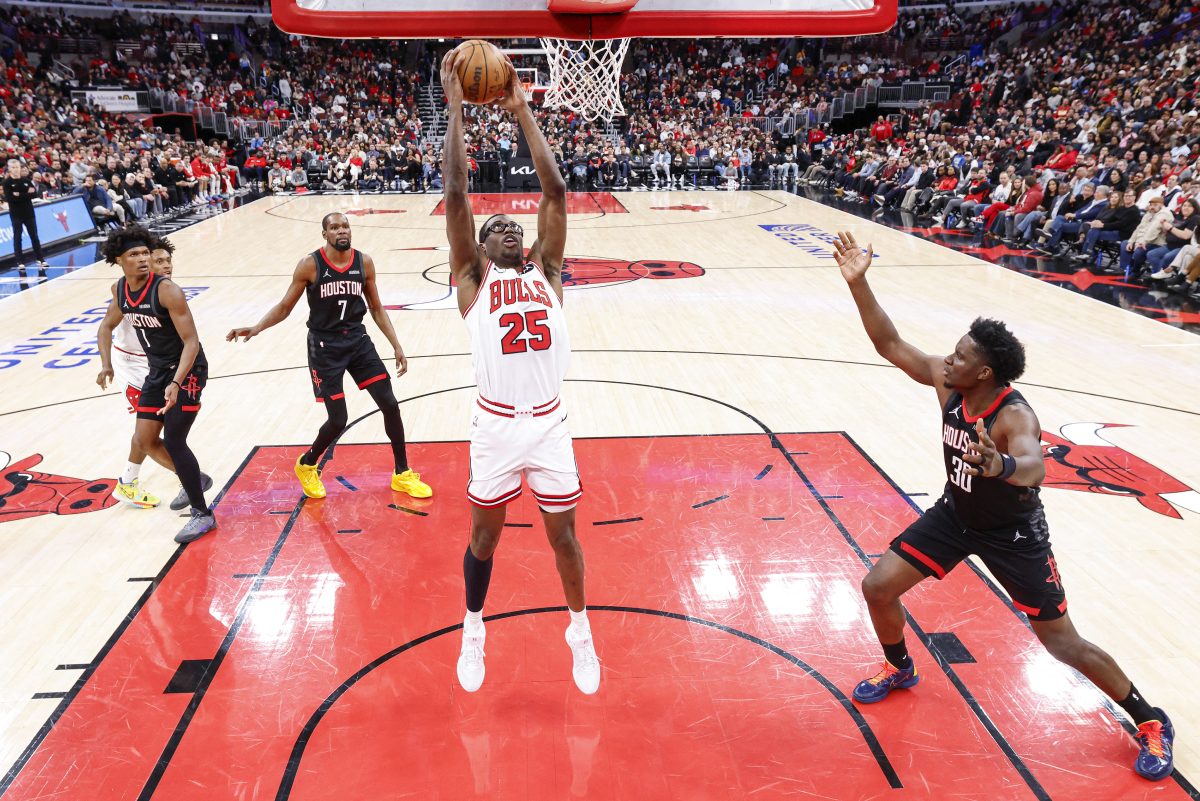
If the mechanics sound abstract, the league has already supplied a concrete example. Dan Woike of The Athletic reported this week that Chicago Bulls big man Jalen Smith has admirers in the Lakers’ front office, writing that Smith “plays with motor and has worked himself into a pretty good outside shooter.”
Woike’s reporting noted the complicating factors: Smith carries $9.5 million remaining on an expiring deal, measures a compact 6-foot-8 for a center and may not even be available, since the previous Bulls regime valued him and the current one has given no signal it wants to move him.
Set aside whether Smith specifically is the answer and look at the shape of the target, because the shape is the point. An expiring contract in the $9 million to $10 million range is precisely what a below-apron team can absorb by aggregating two smaller salaries, and precisely what adds nothing to the 2027 books.
Smith hit 37.3 percent of his 3-pointers last season on more than four attempts per game, the kind of frontcourt shooting the current center rotation of Kessler and Kevon Looney does not offer. Whether the name ends up being Smith or someone with a similar contract profile, that is the template Buha’s “starter now” scenario describes.
The Vanderbilt fork
Every version of the math eventually arrives at Vanderbilt. Toporek’s cap sheet identified the two live options: trade his $12.4 million salary outright, or waive him and stretch the remainder, which would spread a $5.1 million dead-cap charge across each of the next five seasons while creating about $7.3 million in additional spending power.
The stretch route is the desperation lever — five years of dead money on the books of a franchise trying to build cleanly around Luka Doncic is a real cost, and the front office has so far shown no appetite for it.
The trade route is cleaner but runs into the asset problem. After the Kessler deal and the Deandre Ayton salary flip, the Lakers hold zero tradable first-round picks, a single first-round swap in 2032 and three second-rounders.
That is the entire sweetener cabinet. Any deal that requires paying a team to take Vanderbilt, rather than valuing him as a rotation defender, burns capital the franchise cannot replace.
It is the strongest argument for patience — and for letting the Dec. 15 date expand the matching options before spending anything.
Why none of this touches next summer
The second half of Buha’s claim is the part with franchise-level stakes. The Lakers’ cleanest route to the full non-taxpayer mid-level exception in 2027 depends on keeping next season’s books free of new long-term money, and the trade template above does exactly that.
An expiring contract acquired this winter comes off the ledger in July. Existing salaries swapped for other salaries change nothing about the outyears.
The discipline shown across this offseason — one-year minimums at the back of the roster, a revised Reaves structure built with next summer in mind — all points the same direction, toward a front office protecting a spending tool it does not currently possess.
That context also explains the continued interest in Jonathan Kuminga that Buha’s mailbag addressed, which has always run parallel to, rather than against, the flexibility plan. The through line is consistent: every move either helps the 2026-27 rotation, protects the 2027 toolkit or both, and the front office keeps declining moves that trade one for the other.
The Lakers’ July has looked quiet next to the fireworks of early free agency, and quiet gets read as finished. The cap sheet says otherwise.
A team with matching salaries, a salary-absorption advantage its hard cap ironically created and a December calendar full of newly eligible contracts is not a team that is done — it is a team that is early.
Buha said the Lakers are positioned to add a starter, and the mechanics say he is right. The only real question left is whether the front office spends that position in December or saves every last piece of it for July.