
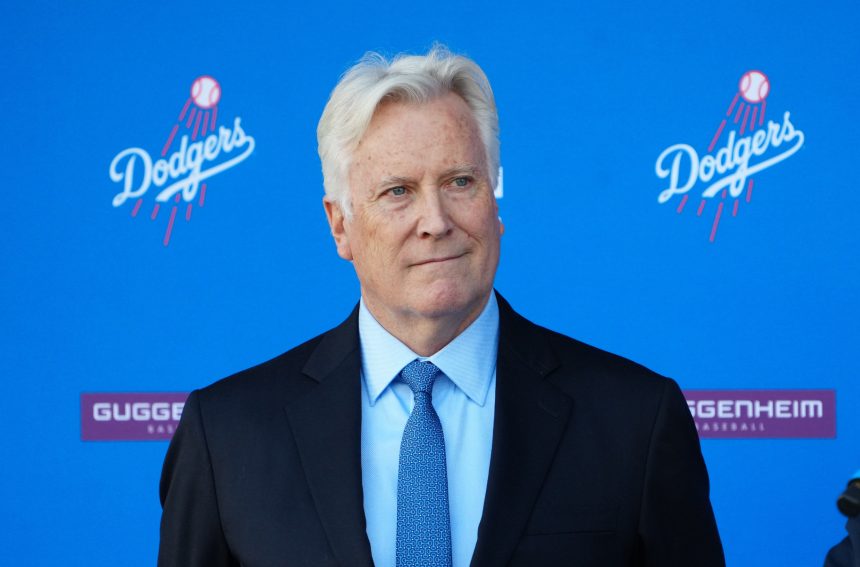
Mark Walter’s holding company said three weeks ago that nobody had claimed to be harmed by the way his insurers handled their money. On Wednesday, somebody did, in federal court, and the Lakers are written into the complaint.
A proposed class action filed in Florida federal court names Walter, Delaware Life Insurance Company, Group 1001, TWG Global and Guggenheim Partners as defendants. The suit accuses the companies of understating how much of their policyholder-backed money was invested in businesses tied to Walter, and it frames the question the same way federal prosecutors reportedly have: whether that money helped bankroll assets like the Dodgers and the Lakers.
The complaint runs nine counts, including fraudulent concealment, breach of contract and aiding and abetting fraud. It does not name a damages figure but anticipates at least $5 million, and it describes a class of “tens of thousands” of annuity buyers nationwide.
The named plaintiff is a 67-year-old Florida resident, Ira Rosner, who says he moved more than $1 million into a Delaware Life annuity in April. The product promised him and his wife $181,677 a year for life starting in a decade, backed by the insurer’s ability to pay.
When the federal investigations became public, he wanted out, but his 30-day return window had already closed.
“It took federal grand jury subpoenas and an internal investigation to force this concealment’s disclosure,” the lawsuit says.
The disclosure at issue is the one that has followed Walter all summer. Delaware Life told regulators in June 2025 that about $1.4 billion, roughly 3 percent of its invested assets, was tied to affiliated companies.
After grand jury subpoenas arrived and the company reviewed its books, it restated that number to more than $17 billion, or about 40 percent.
The timing against Adam Silver’s Tuesday remarks
The filing landed one day after NBA commissioner Adam Silver stood in New York and defended the league’s vetting of Walter.
“We spoke to governmental agencies,” Silver said at his Board of Governors news conference Tuesday. “We spoke to, in the case of Mark Walter, a heavily regulated insurance agency. We spoke to other leagues in which he has investments. We found no red flags.”
Silver was careful to keep the league at arm’s length from the substance.
“Again, even to this day, as you know, these are, call them allegations,” he said.
He added that Walter was not under investigation by the NBA and that he had no idea a sale was coming until the buyers told him they had a handshake deal.
None of that is contradicted by a civil complaint. But the commissioner’s framing, that these remain allegations and that no one has established harm, now has a named counterparty with a policy number and a lawyer.
What the lawsuit says about the Lakers sale
The Lakers are not defendants, and nothing in the filing accuses the franchise itself of wrongdoing. What the complaint does is fold the August flip into its theory of why Walter was raising money.
The suit notes that the Lakers sale came at about the same time Walter “offered to pledge his equity stake in Guggenheim as collateral to secure billions of dollars in short-term loans to his holding company, TWG, reportedly promising lenders double-digit yields.”
It goes on to say that public reporting has linked the proceeds and timing of the sale to Walter’s push to shore up the insurers, while conceding that where the money actually went has not been established.
That is a plaintiff’s characterization, not a finding. But it is now part of a federal docket, and it is the first time a court filing, rather than a news report, has drawn a line from the $12.5 billion Lakers transaction to the insurance problem.
TWG’s own words, three weeks earlier
On Aug. 25, TWG Global issued a lengthy statement pushing back on what it called “multipronged attacks” from unnamed sources. It said flatly that there had been no fraud, and it went further on the question of victims.
“There is no victim here. No one has been harmed, and no one has claimed they were harmed,” the statement said.
The same release addressed the Lakers directly. TWG said Walter was approached by Josh Kushner’s group rather than shopping the team, and it pointed out that the agreed price was a 25 percent premium on what he paid less than a year earlier, “hardly a ‘fire sale.'”
It also said the Dodgers were not for sale and that no sale process had been started. Rosner’s suit does not dispute the premium. Its argument is about what the premium was for.
The 2014 echo
The new complaint leans on history. In February 2014, two policyholders filed a proposed class action alleging that money from Walter-controlled insurers had helped finance the 2012 Dodgers purchase and that the affiliated nature of those investments had been hidden in regulatory filings.
That case was withdrawn the day after it was filed, without prejudice, and the forensic accountant behind it told FOS his clients “seemed pleased” with the outcome. The new suit cites that episode to argue the defendants “knew, long before the Class Period,” that concealing affiliated investments from regulators and policyholders was unlawful.
TWG, for its part, has said the Dodgers deal was reviewed by an outside law firm on behalf of insurance regulators in multiple states and that no irregularities were found.
Where the Lakers sale actually stands
Walter is still the Lakers’ controlling owner. The agreement to sell roughly 65 percent of the team to Kushner and Bob Iger at a $12.5 billion valuation needs a Board of Governors vote, and that vote was not expected to be on this week’s agenda in New York.
The Buss family piece is on its own clock. Jeanie Buss filed a petition Aug. 23 arguing that a 2017 court order requires her family to keep her in the governor’s chair, and her challenge to her siblings’ vote to sell the trust’s 17.8 percent stake is set for a Dec. 8 hearing after a continuance from Nov. 5. The family dispute is not expected to derail the Kushner-Iger transaction itself, but the timeline for closing has never been publicly set.
Meanwhile, Walter’s exits keep coming. He sold his Chelsea stake to Clearlake Capital on Wednesday, with Todd Boehly selling his as well.
And Delaware Life disclosed last month that TWG will buy up to $6.5 billion of the insurer’s affiliated investments and hand back an equal amount of unaffiliated assets, a step the company describes as a remediation plan.
What this does and doesn’t change for the Lakers
On the basketball side, nothing. Jeanie Buss remains the governor of record, Rob Pelinka’s front office has spent September adding staff and the team that opens against the Warriors on Oct. 21 is unaffected by a Florida annuity dispute.
The ownership side is more complicated. The NBA’s approval process is built around vetting the buyer, and Kushner and Iger are the ones who need 23 of 30 votes.
From the league’s perspective, a seller with growing legal exposure is arguably a reason to move faster, not slower. Silver said Tuesday the league had no prior notion Walter wanted out, and nothing in his remarks suggested the board intends to hold the sale hostage to the insurance matter.
But every week the vote does not happen is a week in which the man who controls the Lakers is accumulating filings with the team’s name in them. Wednesday’s complaint puts the $12.5 billion figure, and the reasons behind it, into a courtroom for the first time.
The plaintiffs are not asking a judge to touch the Lakers. They are asking a judge to decide whether the money that bought the Lakers was ever Walter’s to spend.
Until the Board of Governors votes, that question and the franchise remain tied together.