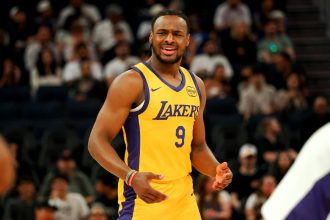

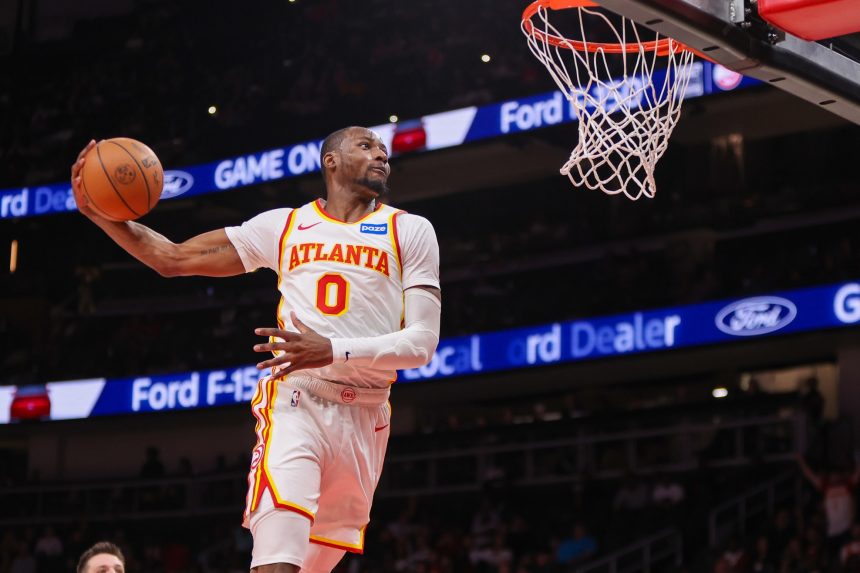
The Jonathan Kuminga standoff finally has a shape. The Atlanta Hawks are willing to send the athletic wing to the Lakers in a sign-and-trade, and the framework under discussion would send Jarred Vanderbilt and the Lakers’ 2032 first-round pick swap back to Atlanta, Khobi Price of the California Post reported Wednesday, citing a source.
That swap is the only first-round pick Los Angeles is permitted to trade this summer, a consequence of the two firsts and two additional swaps the Lakers surrendered to pry Walker Kessler out of Utah. Beyond it, the cupboard holds three second-round picks and little else.
So the outline of a deal exists. What does not exist, yet, is a version of it that both sides actually want to sign, and the reasons are buried in the fine print rather than in anyone’s willingness.
What Atlanta gets out of it
The Hawks declined Kuminga’s $24.3 million team option on June 29, which made him an unrestricted free agent but left Atlanta holding his Bird rights.
Those rights are the entire reason this conversation is happening. A sign-and-trade lets Atlanta pay Kuminga more than the Lakers can on their own, then route him to Los Angeles and collect something for a player it had already decided not to keep.
Atlanta is open to facilitating exactly that, but general manager Onsi Saleh would need a reason to say yes. Vanderbilt and a distant pick swap may or may not clear that bar. The Hawks would be absorbing a rotation player they do not obviously need, and the swap in question does not convey for another six years.
The Lakers have several salaries they could route out to build a bigger offer, including Vanderbilt, Dalton Knecht and Jaden Hardy, and they would likely need to attach at least one of their remaining picks to make any of it work.
The three-year rule nobody is talking about
Here is where the framework runs into trouble. A player acquired through a sign-and-trade must sign a contract of at least three seasons, a wrinkle Heavy’s Sean Deveney pointed out Wednesday. That single requirement cuts against what both sides have spent two weeks pursuing.
Consider what the Lakers have actually pitched. Rob Pelinka and JJ Redick met with Kuminga virtually on June 30 and sold him on heavy minutes and a likely starting job alongside Luka Doncic. The unstated trade was a modest salary now in exchange for a platform, with another crack at free agency once he had proved the leap on the league’s most visible team.
A sign-and-trade erases that bargain. It locks Kuminga in for three years at a moment when his leverage is at its lowest, and it commits the Lakers to a player whose production has never quite matched his athleticism.
The mechanism that solves the money problem creates a commitment problem, which is a large part of why a deal that looks obvious on paper has not closed.
The money is still the gap
None of the machinery matters if the number stays where it is. Price reported that the Lakers have raised their offer to an average salary near $10 million, which would place Kuminga beneath both Quentin Grimes at $13.9 million and Sandro Mamukelashvili at $13 million on next season’s payroll.
The Los Angeles Times previously put the offer at two years and $20 million with a player option. Price’s assessment was blunt. He wrote that “a $10 million salary for Kuminga won’t get a deal done” at this stage.
The Lakers arrived here by choice. They spent the bulk of their room on Kessler, Mamukelashvili, Grimes and Collin Sexton, and only afterward, discovered that the wing they had personally recruited was priced above what remained.
Pelinka has stayed in contact with agent Aaron Turner and has quietly improved the offer, while Kuminga’s camp continues to believe a better situation will surface as the summer’s remaining dominoes fall.
They are not wrong to wait. Cleveland retains interest, in part because Kuminga spent his first three NBA seasons working under Kenny Atkinson in Golden State, though the Cavaliers are consumed by the LeBron James pursuit.
Sacramento has circled back but is financially boxed in and has resisted the sign-and-trade it would need. For now, the Lakers are the most aggressive suitor in the room.
What he would actually give them
Stripped of the intrigue, Kuminga is a 23-year-old forward who turns 24 in October, and the case for him is physical rather than statistical.
He averaged 12.2 points, 5.6 rebounds and 2.3 assists per game across 36 games last season between Golden State and Atlanta, shooting 46.3 percent from the field and 33.3 percent from 3-point range. He was slightly sharper in his 16 games as a Hawk, at 12.3 points and 5.3 rebounds per game on 34.6 percent shooting from deep.
The durability question is real. Kuminga has appeared in 36 and 47 games over the past two seasons, and the shooting has never stabilized, sitting at 33.2 percent from distance for his career.
What he offers is the thing this roster conspicuously lacks: a long, explosive forward who finishes above the rim and can defend across positions when locked in — the archetype Los Angeles has been missing since it let Rui Hachimura walk to the Clippers.
The Lakers have one roster spot left and have earmarked it for him. Filling it now requires Atlanta’s cooperation, a three-year commitment neither side originally wanted, a salary the Lakers have not yet offered and the last first-round swap they own.
That the Hawks are willing is genuine progress. It is also, for the moment, the easiest part.