
The Los Angeles Lakers have spent the past week making it plain that they want Jonathan Kuminga. What they have not done, according to a Tuesday report from ESPN’s Anthony Slater, is put a number in front of him that makes signing an easy decision.
Slater reported that Los Angeles remains the most aggressive suitor in the Kuminga market but has yet to table an offer enticing enough to get the 23-year-old forward to commit — a distinction that captures exactly where this pursuit sits roughly a week into free agency.
The interest is real, and it is not new. Kuminga has sat at the top of the Lakers’ wing board for days, as we detailed when reporting emerged that he had passed Rui Hachimura in the team’s plans. The gap now is financial, and it is the direct byproduct of how hard the Lakers hit the rest of their roster first.
What the Lakers have actually offered
Per Slater, the sequence started the day after Atlanta declined Kuminga’s $24.3 million team option on June 29. Kuminga hopped on a virtual meeting with general manager Rob Pelinka and head coach JJ Redick, who sold him on a defined, heavy-minutes role on the wing beside Luka Doncic, in an offense with enough spacing to let his athleticism breathe.
Then the Lakers went shopping. They funneled the bulk of their spending flexibility into Walker Kessler, Sandro Mamukelashvili, Quentin Grimes and Collin Sexton, and by the time that spree was done there was almost nothing left to make Kuminga a competitive proposition. That is the whole standoff in one sentence: the pitch was strong, but the check Los Angeles can currently write is not.
Pelinka has kept a line open to Kuminga’s agent, Aaron Turner, and has inched the offer higher over the past several days while reminding Kuminga how central he would be to the group forming around Doncic. Members of the organization, players included, have reached out directly to press the same case.
So far it has not moved the needle. Kuminga’s camp believes a better payday is still out there as the rest of the league’s dominoes fall, and it is comfortable waiting for one rather than accepting what the Lakers can offer today.
The cap math that boxed them in
To understand why a franchise with the Lakers’ resources is stuck offering scraps, start with the Kessler trade, the move that set the ceiling on everything that followed. Because Los Angeles acquired Kessler in a sign-and-trade, the team is hard-capped at the first apron for the coming season, and that line governs every subsequent decision.
After the run of signings, the minimum salary exception is essentially the only tool left in the drawer — and a minimum is not prying loose a player the Lakers themselves rank as their top remaining wing.
Jovan Buha of The Athletic laid out the only two realistic routes in a video breakdown on Monday: The Lakers either manufacture cap space by shedding salary, or they go get Kuminga from above the cap through a sign-and-trade. Neither path is clean.
The sign-and-trade route runs through Atlanta, and it exists because of how the Hawks handled Kuminga’s exit. By declining his option rather than renouncing him, Atlanta kept his Bird rights, which means the Hawks can still be the mechanism that pays him — either on a fresh deal to stay, or as the outgoing team routing him elsewhere.
Atlanta is willing to help engineer an outcome that lets Kuminga hold onto those rights and land the contract he wants, but Hawks general manager Onsi Saleh would need a genuine incentive to play along rather than doing anyone a favor.
What a deal would take
This is where it gets expensive for Los Angeles. To generate the outgoing salary a sign-and-trade requires, the Lakers would likely have to package some combination of midsized contracts — Slater pointed to Jarred Vanderbilt, Dalton Knecht and Jaden Hardy — and then attach draft equity to close it.
That sweetener, per ESPN, would probably come from the team’s remaining stockpile of three second-round picks and a 2032 first-round pick swap.
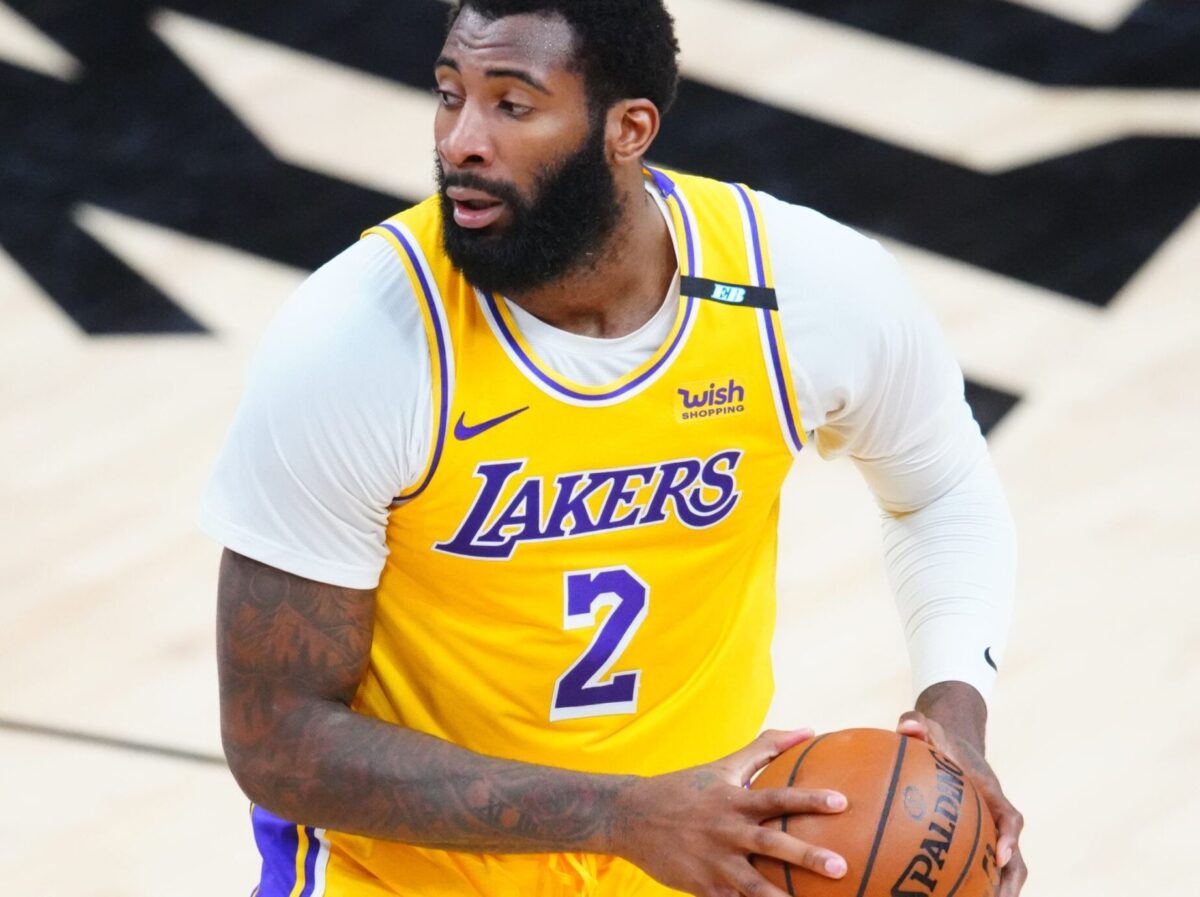
Hardy is only on the roster because of last week’s Deandre Ayton salary dump, which quietly handed the Lakers a movable contract to work with.
None of that is free. Draft picks attached to a salary-clearing trade are simply the cost of doing business once you have spent your cap room, and the Lakers do not have an endless supply of them. That is the tension Pelinka is managing: how much of the team’s future to spend chasing a 23-year-old two other franchises could not fully unlock.
The Hachimura precedent hanging over it
The Lakers have already shown, days ago, how they weigh that trade. When the Clippers and Lakers talked through a possible Rui Hachimura sign-and-trade, Los Angeles wanted draft capital coming back and the Clippers were only willing to send minimal cash, so the Lakers let the deal die rather than facilitate his exit for little, ESPN’s Shams Charania reported. Hachimura then signed a two-year, $28 million deal to stay in Los Angeles with the Clippers.
That is the same asset-first calculus now pointed at Kuminga, only inverted. On Hachimura, the Lakers refused to give up value to help another team.
On Kuminga, they would be the ones asked to surrender it. Whether the front office is willing to pay a price on the way in that it wouldn’t accept on the way out is the real question of this pursuit.
He is not the only option, and L.A. is not his only suitor
Kuminga has leverage precisely because the Lakers are not bidding alone. Cleveland remains interested, in part because Kuminga is comfortable with Cavaliers coach Kenny Atkinson, who spent Kuminga’s first three pro seasons on Golden State’s bench as a lead assistant.
For now the Cavaliers are consumed by the LeBron James sweepstakes, which is part of why the Lakers have been able to cast themselves as the most aggressive pursuer — at least until the James decision lands and the market thaws.
There are other threads. Slater noted a scenario in which Kuminga simply returns to Atlanta on a more team-friendly number than the option the Hawks just turned down, though he reported that such a reunion is not being actively discussed. Sacramento, which chased Kuminga hard a year ago, has circled back but is financially handcuffed and would need its own sign-and-trade to get involved.
The player at the center of it
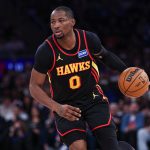
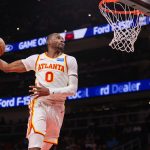
The bet, for any of these teams, is on tools that two organizations have not quite harnessed. Kuminga, a 6-foot-7, 225-pound forward, was the seventh pick in the 2021 draft and won a title as a rookie in Golden State in 2022 before the Warriors dealt him to Atlanta in a February trade.
Splitting the 2025-26 season between the two teams, he averaged 12.2 points, 5.6 rebounds and 2.3 assists per game on 46.3 percent shooting and 33.3 percent from 3-point range across 36 games, according to Basketball-Reference.
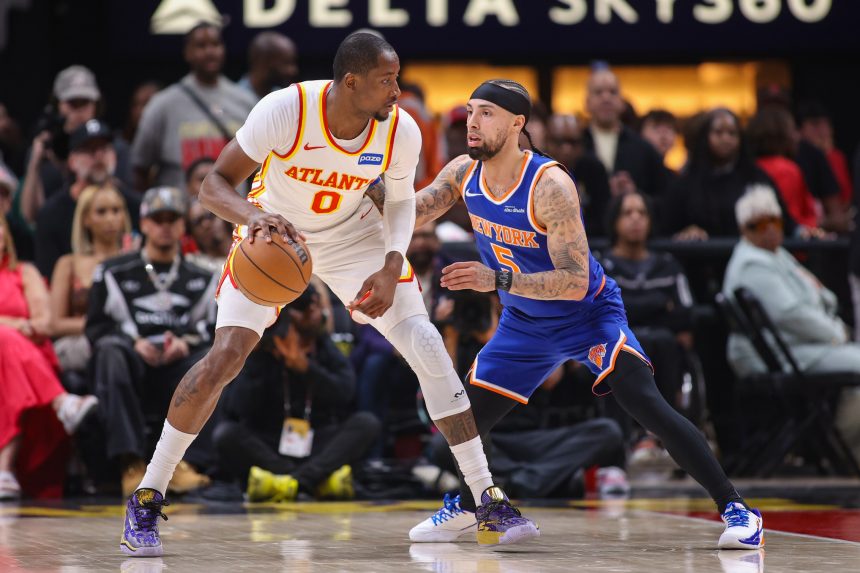
He also flashed the ceiling that keeps front offices circling, dropping 21 points in a Game 3 win over the Knicks during Atlanta’s first-round series. The athleticism, the transition scoring and the defensive versatility are the exact traits a Doncic-led group lacks on the wing, a hole that stands out on the team’s projected post-overhaul depth chart. The questions — consistency, outside shooting, role acceptance — are the same ones that followed him out of the Bay.
Where it stands
For now, the Lakers are doing the only two things available to them: keeping the relationship warm and quietly probing the trade machinery that would let them make a real offer. Kuminga is doing the only thing that makes sense on his end, waiting to see whether a cleaner, better-paying opening appears once James picks a team and the next wave of money moves.
The Lakers have made their interest impossible to miss. Whether they can turn that interest into a figure Kuminga will actually sign may not be settled until the rest of the league moves first.