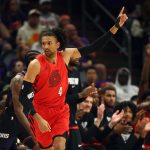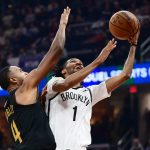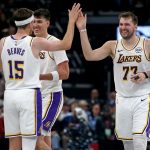

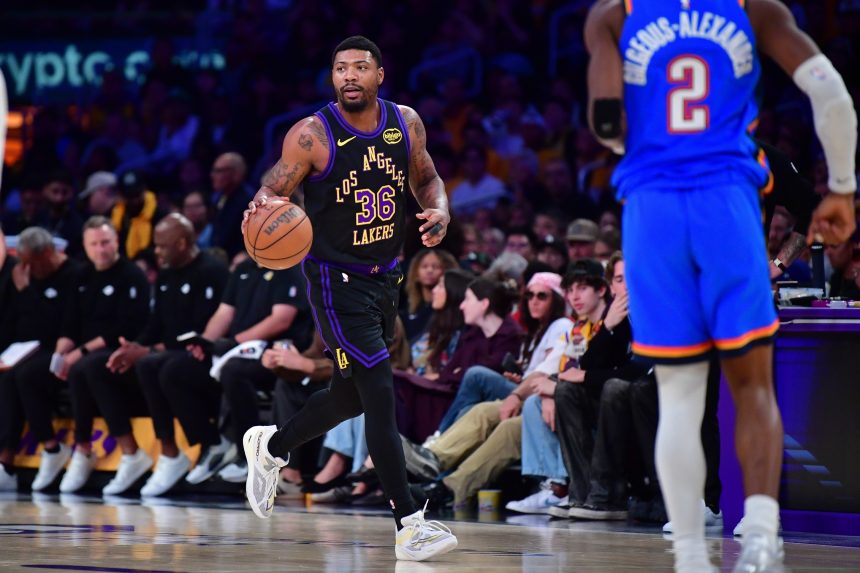
Marcus Smart wanted the Los Angeles Lakers to reward his play with greater security.
He told the Houston Chronicle’s Varun Shankar that their offer was “disrespectful,” even though Houston offered less money.
“First off, I played so well that the offer that was ultimately given didn’t match the way that I played,” he said, “especially when you see guys who played way worse than I did, the offers they’re getting. And then it wasn’t any security that we wanted that they were willing to do.”
His strongest basketball argument comes from the responsibilities he handled when the Lakers needed more than a perimeter defender. Evaluating his departure means looking at whether Los Angeles can replace that combination of skills, particularly when its preferred offensive options are unavailable.
Smart gave the Lakers another way to create offense
Game 3 against Houston in April offers a concrete example. Smart delivered 21 points and 10 assists in a 112-108 overtime victory with Luka Doncic and Austin Reaves unavailable.
Eight of his points came in overtime. That performance matters to this discussion because it demonstrated an additional use for a player whose defensive contributions already gave him a reason to be on the floor.
Smart could take responsibility for initiating possessions when the Lakers were missing two central offensive options. There was a tactical basis for that success.
In Raj Chipalu’s film breakdown for Silver Screen and Roll, Smart repeatedly brought Reed Sheppard’s assignment into screening actions. On one possession, drawing a second defender opened a 3-point opportunity for Rui Hachimura.
When Houston defended underneath screens, Smart also attacked the available space to set up lobs. Those examples explain why replacing his scoring average alone would be an incomplete measure.
A guard who can identify the matchup, force help and deliver the next pass gives a coach another way to start an effective possession. That can become especially valuable when an opponent disrupts the first action or an injury changes the rotation.
His shooting also puts a limit on the argument
Against Oklahoma City, Smart shot 13-for-43 overall and 4-for-21 from 3. That is a meaningful counterweight to using the Houston performance as a complete assessment of his value.
The ability to make a productive read does not eliminate the need to finish possessions, and a defense has more room to adjust when it can live with the resulting shot.
Both stretches are small samples. Together, they support a narrower conclusion: Smart supplied useful playoff versatility, but the Lakers still had reason to consider offensive consistency when evaluating what that versatility was worth.
That is a basketball assessment, not evidence of the front office’s actual negotiating rationale.
The replacement test extends beyond defense
The same issue informs Matisse Thybulle’s case for a Lakers closing role: A defender’s ability to remain useful on offense helps determine whether a coach can leave him on the floor through consecutive possessions.
For Los Angeles, replacing Smart’s contributions could require different players for different situations. That approach can work. Its test will come when the team needs ballhandling and a defensive stop from the same group, without a timeout or dead ball to change personnel.
The Lakers’ offer details remain undisclosed, so a definitive judgment on the negotiation is premature. The basketball question is more concrete: Can their preferred perimeter combinations defend effectively while also producing a useful possession when the first scoring option is taken away?