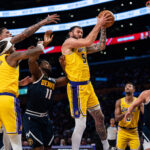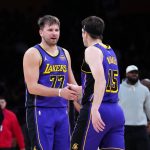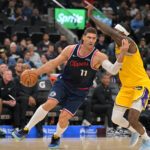

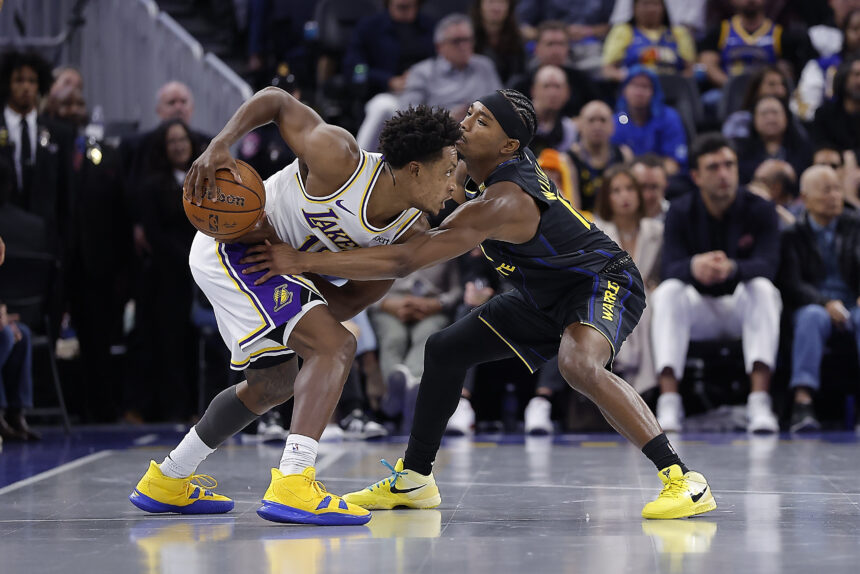
The Los Angeles Lakers have a problem opponents may be eager to test again after their loss to the Golden State Warriors: how they respond when defenders crowd the ball.
The Athletic’s Dan Woike reported Saturday that players he spoke with after the game said they would emphasize traps and pressure if they were preparing to defend the Lakers.
Spoke with a couple of players postgame who acknowledged that if they were trying to guard the Lakers right now, they’d trap and pressure as much as possible. https://t.co/zLcInjvB68
— Dan Woike (@DanWoikeSports) October 31, 2026
Woike did not identify those players in his post. But their assessment points to a specific challenge for Los Angeles: making opponents pay for sending extra attention toward its ball-handlers.
Luka Doncic acknowledged that challenge himself. Asked about handling double-teams and blitzes after Friday’s game, he gave Woike a blunt response.
“We’ve got to be way better at this,” Doncic said.
The issue is especially consequential because trapping creates an opportunity as well as a threat. When two defenders commit to the ball, the offense can gain a numerical advantage elsewhere.
Getting the pass out safely is only the first step; the receiving player and his teammates still have to turn that opening into a shot before the defense recovers.
Austin Reaves’ turnovers are part of a larger Lakers problem
Reaves finished with eight turnovers for the second consecutive game. That puts his ball security under scrutiny, but the numbers alone do not establish who was responsible for every breakdown or how many giveaways came directly from traps.
Reaves accepted responsibility in his postgame interview, telling Spectrum SportsNet that he needed to improve.
“I have to be better,” Reaves said.
“I have to be better.”
— Spectrum SportsNet (@SpectrumSN) October 31, 2026
Austin Reaves on tonight' loss to the Warriors. pic.twitter.com/FSflHp6zaj
The early second-quarter stretch illustrated how quickly the Lakers could lose control of possessions.
Golden State opened the period with a 13-2 run while Doncic was off the floor. With 9:30 remaining in the quarter, Los Angeles called timeout leading 40-28, and Reaves already had four turnovers.
For the coaching staff, evaluating that sequence requires more than counting mistakes. A ball-handler needs a usable passing outlet, while the players away from the ball must recognize where the extra defender has come from.
A late pass, a poor angle or hesitation after the catch can each allow the defense to regain control. Those are different problems with different corrections.
Treating every turnover as evidence that Reaves simply needs to dribble less would miss the responsibility of the other four players to help keep the possession moving.
The minutes without Luka Doncic made the challenge more costly
The full-game split was severe.
| Doncic’s status | Minutes, rounded | Lakers scoring margin |
|---|---|---|
| On the floor | 37 | +9 |
| Off the floor | 11 | -26 |
That is a description of Friday’s game, not proof that one player or one defensive coverage explains the entire loss.
Different teammates and opponents share those minutes, and the split does not separate turnovers from missed shots or defensive mistakes.
It does show why Los Angeles could not rely on its productive stretches with Doncic to carry the night. The damage during his rest overwhelmed the advantage built while he played.
The reserves also supplied little scoring relief.
The Lakers’ bench tonight vs. Golden State: 7 points on 3-for-16 shooting.
— Jovan Buha (@jovanbuha) October 31, 2026
Those totals should not be treated as a count of failed possessions against traps, but they show that improving passing alone would not address every offensive problem.
The Lakers had recently received encouragement from a different bench combination.
As Lakers Daily covered after the Clippers game, JJ Redick liked pairing Jarred Vanderbilt with Sandro Mamukelashvili because of the latter’s shooting and playmaking alongside Vanderbilt’s defensive contributions.
That context makes the next evaluation more specific: whether the combinations Redick uses can both protect the ball and create useful shots against pressure.
One poor night does not establish that a pairing should be abandoned, just as an encouraging performance does not settle the rotation.
Los Angeles fell to 4-2 with the 112-95 defeat and next hosts Toronto on Sunday. The Raptors game will provide another opportunity to assess the response, although there is no confirmed indication here of what coverages Toronto will choose.