
When LeBron James told the Lakers on June 30 that he would play elsewhere during the 2026-27 season, the basketball world made an immediate assumption about the other James on the roster. Bronny, the thinking went, was a formality — a small contract the Lakers would happily ship to whichever team lands his father, completing the reunion and clearing a roster spot in one move.
That assumption keeps running into the same problem: The people who actually make the decision do not share it. New reporting from California Post Lakers beat writer Khobi Price puts the sharpest edge yet on where the organization stands, and it turns the Bronny conversation from a question of whether into a question of price.
What Khobi Price is reporting
In a story published Wednesday night, Price reported there is a real possibility the Lakers carry Bronny into next season even as they continue adjusting the roster to reach compliance with the league’s limits before opening night. If the team that signs LeBron also wants his son, Price reported, that team would likely need to send the Lakers a genuine asset in return, because Bronny has supporters at multiple levels of the organization.
Price went further in an appearance on 97.1 The Fan clipped by the station earlier this week. A front office that drafted Bronny, developed him and considers itself a fan of his is a group with no interest in shipping him off as a courtesy.
"It would take something REAL for the Lakers to want to trade Bronny… they developed him, they’re a fan of him, and he has A LOT of supporters in the building."@khobi_price joined #BrockandAlex to discuss everything #Lakers offseason & what to look forward to going into the… pic.twitter.com/3mpWW6UBjV
— 97.1 The Fan (@TheFanLA) July 21, 2026
“It would take something real for the Lakers to want to trade him,” Price said.
That language matters because it echoes what the team’s beat has been signaling for weeks. Dan Woike of The Athletic reported earlier this month that Bronny was with the Lakers at their veteran minicamp and that “the assumptions about his future are kinda false.” Price’s reporting is not a new thesis so much as a price tag attached to an existing one.
The contract that gives the Lakers leverage
The reason the Lakers can hold this position comfortably comes down to the numbers on Bronny’s deal. The team guaranteed his $2.3 million salary for 2026-27 by keeping him on the roster past June 29 — a commitment made one day before LeBron delivered his decision.
Bronny also carries a $2.5 million team option for 2027-28, and that season’s salary does not become fully guaranteed until Jan. 10, 2028. Read those terms from the front office’s chair.
A guard on a minimum-scale deal with a team option costs almost nothing against the cap, carries no long-term risk and remains easy to move at any point if the right offer arrives. There is no financial pressure forcing a decision, no looming guarantee date this season and no scenario where keeping him hurts the flexibility Rob Pelinka has spent the summer protecting.
The contract is small enough to trade in nearly any construction and cheap enough that trading it for nothing would be pure charity. That is the leverage.
Teams pursuing LeBron may view Bronny as the finishing touch on a recruiting pitch, but the Lakers hold an asset whose value to those specific suitors exceeds what the deal itself would suggest, and they are under no obligation to discount it.
The on-court case for keeping him
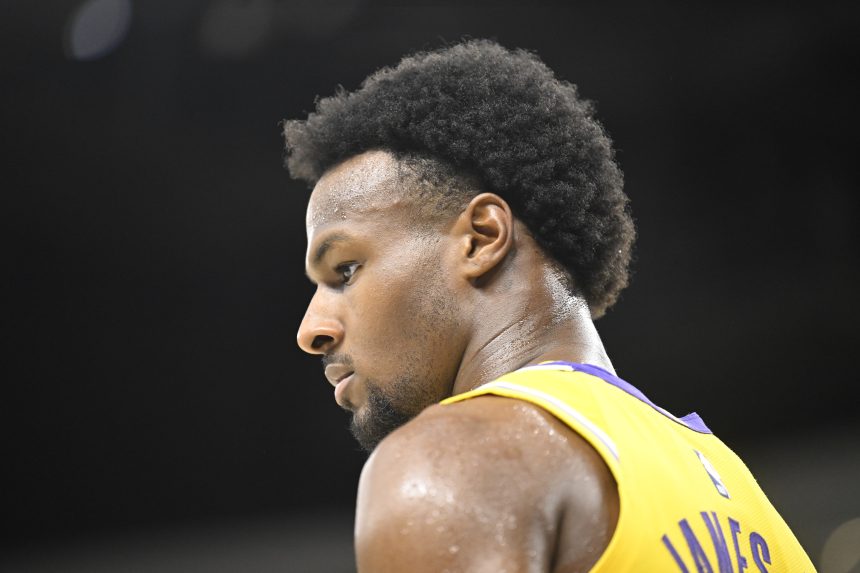
The organizational fondness is not sentiment detached from basketball. Bronny appeared in 42 regular-season games in 2025-26 after playing 27 as a rookie, and when season-ending injuries to Luka Doncic and Austin Reaves gutted the backcourt, he became a full-time rotation player rather than a curiosity.
Over the final 10 games of the regular season, he averaged 5.6 points per game and shot 35.7 percent from 3-point range. The postseason extended the case.
Bronny appeared in eight of the Lakers’ 10 playoff games, and his most memorable stretch came in the second quarter of the Game 3 win over Houston in the first round, when he and LeBron combined for 10 straight points — a sequence that doubled as the signature father-son moment of their two seasons together.
The Lakers drafted him with the No. 55 pick in 2024, making the two the first father-son duo to play together in league history, and have watched his shooting and decision-making climb steadily through two years of development work with their G League affiliate.
None of that makes him untouchable. It does mean the Lakers evaluate him as a developed 6-foot-2 guard on team-friendly money, which is exactly the profile front offices spend second-round picks hoping to find.
What it means for the LeBron sweepstakes
The teams chasing LeBron understand the sweetener logic perfectly well, which is why Bronny’s name surfaces in nearly every reunion scenario. What Price’s reporting clarifies is that the sweetener is not free.
A courtesy second-round pick appears unlikely to move Pelinka, and any suitor budgeting for a LeBron pitch now has to budget for a real outgoing asset if the pitch includes his son. The roster math cuts both ways.
The Lakers do need to trim to reach the regular-season limit, and moving a young guard would technically help. But reporting suggests the front office sees other paths to compliance before it sees a Bronny giveaway, and if the eventual resolution involves him at all, the return will have to justify it on basketball terms rather than narrative ones.
If Bronny opens the season in purple and gold, he is expected to compete with Collin Sexton, rookie Cameron Carr and Jaden Hardy for reserve backcourt minutes. That is a real competition on a real roster, not a placeholder role waiting on a phone call from his father’s new team.
The LeBron decision will come when it comes, and the moment it does, the calls about Bronny will follow within minutes. The reporting out of Los Angeles this week says those calls will be answered with a price, and the price will not be small.