
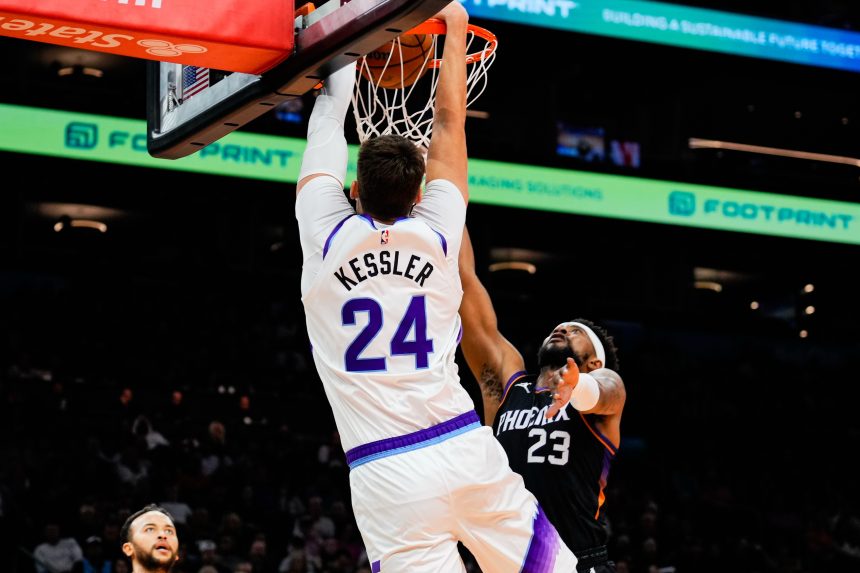
The Utah Jazz expected to keep Walker Kessler before the Los Angeles Lakers offered enough to change their plans.
Jazz president of basketball operations Austin Ainge explained that decision in an interview with UtahJazz.com’s JP Chunga and Eric Spyropoulos.
In the team’s interview recap published Friday, Ainge said Utah still valued Kessler but ultimately preferred the return Los Angeles put on the table.
“But that offer got high enough that we thought it was the right move to make for the Jazz,” Ainge said, explaining that the decision served Utah’s championship-building plans.
Austin Ainge on the Walker Kessler trade:
“ We really valued Walker. Walker's a good player. We were planning on keeping him. But that offer got high enough that we thought it was the right move to make for the Jazz for building a championship team." pic.twitter.com/6wTuRYeaGY
— Eric Spyropoulos (@EricSpyroNBA) September 26, 2026
The comment adds the selling team’s perspective to a deal that committed significant Lakers resources to the center position. Utah’s willingness to trade Kessler came with a price; Ainge’s account makes clear that keeping him had been a real option.
What the Lakers gave up for Walker Kessler
In his July 1 report on the agreement, ESPN’s Shams Charania detailed the package: Utah would receive the Lakers’ unprotected first-round picks in 2031 and 2033, plus first-round swap rights in 2028 and 2030.
Kessler’s new contract was for four years and $130 million. The distinction between the picks and swaps matters.
The deal includes two outright first-round selections, with the swaps giving Utah opportunities to improve its draft position in two other years. Those swaps do not represent two additional selections disappearing from the Lakers’ draft altogether.
The unprotected picks carry a different risk. Their eventual value depends on where Los Angeles lands years from now, leaving the Lakers exposed if the team declines before those drafts.
Utah also had a reason to expect compensation. Kessler was a restricted free agent, allowing the Jazz to match another team’s offer.
Los Angeles could pursue an offer sheet, but that route would still leave Utah with a decision over whether he departed.
Ainge’s explanation reinforces that distinction: The Lakers were negotiating with a team prepared to retain the player.
His comments do not establish whether a smaller package could have worked, but they explain why Utah chose the one it accepted.
Why the Lakers invested in Kessler’s fit
Los Angeles was pursuing a specific partner for its lead guard. Doncic had expressed a desire to play with a high-level center and that the Lakers had tried to acquire Kessler before this offseason.
The production behind that interest predates his arrival. In 2024-25, Kessler averaged 11.1 points, 12.2 rebounds and 2.4 blocks per game across 58 appearances.
The Lakers finished 29th in offensive rebounds per game last season, while Kessler had led the league with 4.6 per game in 2024-25.
Recovering misses would give Los Angeles additional scoring opportunities without requiring Doncic or Austin Reaves to manufacture a new opening against a set defense.
JJ Redick described the defensive assignment at Thursday’s preseason press conference, as covered in his explanation of the Lakers’ improved roster fit.
“I think Walker is a perfect fit for Luka and AR, just in terms of his rim protection,” Redick said.
That gives the investment a concrete basketball purpose. Kessler is being counted on to contest shots behind the perimeter defenders and help finish possessions with rebounds.
His value to this group will depend on how consistently those skills support the players around him. There is also a substantial recent gap in his playing record.
Kessler appeared in only five games last season, and Utah announced in November that he needed surgery for a torn left shoulder labrum and would miss the rest of the season.
The Lakers are backing both his established production and his ability to sustain it after that absence.
Ainge has explained why Utah accepted the future assets. The Lakers’ side of the bargain now rests on Kessler turning a projected fit into reliable production alongside Doncic and Reaves.