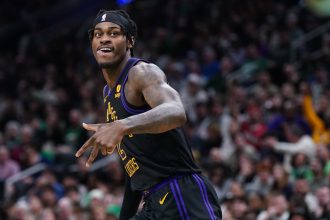

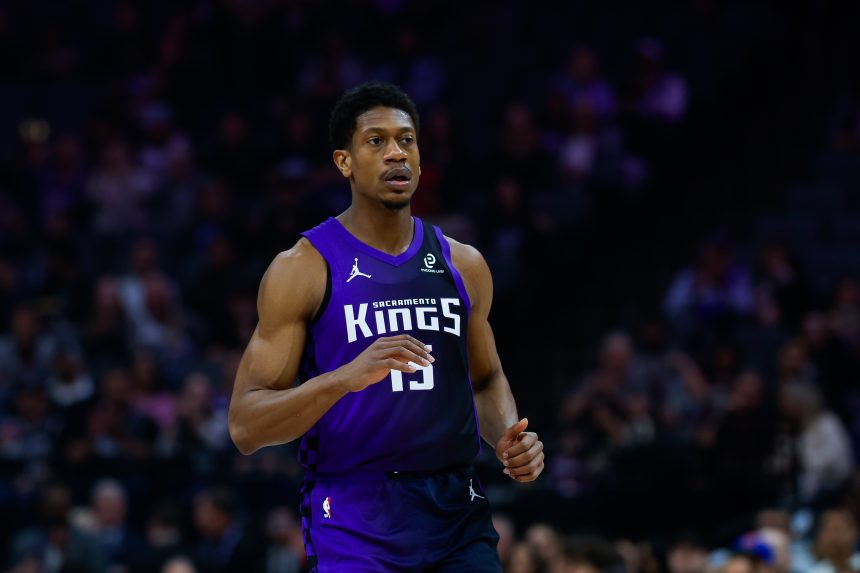
The Los Angeles Lakers have spent the offseason auditioning names for the forward spot next to Luka Doncic, and the newest one on the list is also the oldest. De’Andre Hunter, now with the Sacramento Kings, was drafted by the Lakers with the No. 4 overall pick in 2019 — a pick that belonged to Los Angeles for only a few hours before it was rerouted as part of the Anthony Davis blockbuster, sending Hunter’s rights on a path to Atlanta.
Seven years later, the two sides keep circling back toward each other, and this time the trade math gives the connection a realistic shape.
Khobi Price of The California Post reported in late July that Hunter stands out as one of the Lakers’ best trade options if the Jonathan Kuminga pursuit collapses, and Bleacher Report’s Eric Pincus ranked Hunter among the top three targets to finalize the Lakers’ 2026-27 roster this week.
With Jovan Buha’s latest Lakers mailbag still debating where the team would rank with an upgrade at the 4, the question has stopped being whether the Lakers need a starting forward and started being which one is actually gettable.
How Hunter got back on the Lakers’ radar
The Lakers’ interest in Hunter did not start this summer. According to Price, the front office looked into trading for the veteran forward before the deadline in February, only for the Cleveland Cavaliers to send him to Sacramento first as part of a three-team deal with the Chicago Bulls.
“The Lakers previously had interest in trading for Hunter ahead of the deadline in February before the Cavaliers sent him to the Kings as part of a three-team deal with the Bulls,” Price wrote.
That history matters because it separates Hunter from the parade of hypothetical names attached to the Lakers this offseason. This is a player the front office has already vetted once, at a moment when it was actively shopping for the same roster need it has today.
Price framed Hunter, along with Milwaukee’s Kyle Kuzma, as the best trade options for a forward who could start without jeopardizing the Lakers’ access to the mid-level exception next offseason — a constraint that quietly rules out most of the bigger names fans keep proposing.
The Kuminga stalemate is the backdrop. The Lakers have chased the Atlanta free agent for much of the summer, but a workable sign-and-trade remains unlikely given the three-year commitment required and the Lakers’ thin asset base.
Kuminga remains context here rather than the story, because the story is what happens when that door closes.
What a Lakers-Kings trade actually costs
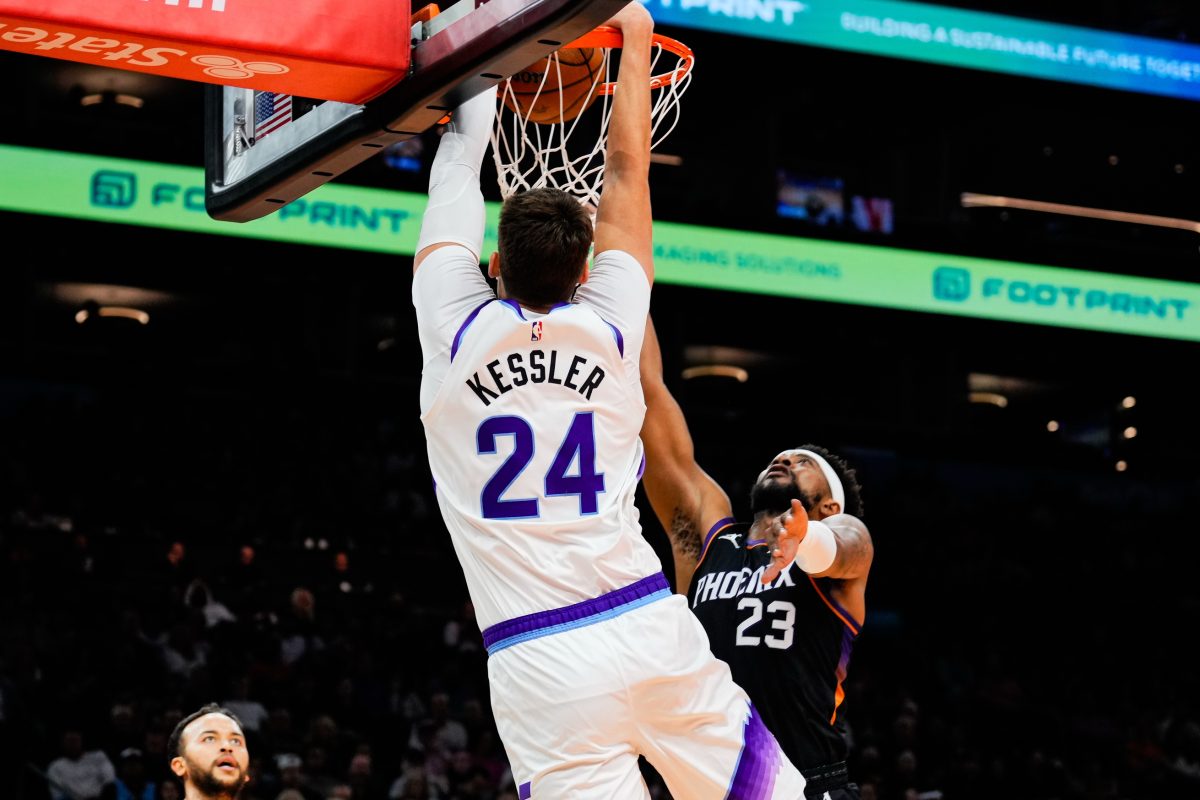
The Lakers are hard-capped at the first apron, a consequence of the Walker Kessler sign-and-trade, and their remaining trade assets amount to a 2032 first-round pick swap and three future second-round picks. That is not a package that wins a bidding war, which is precisely why Hunter fits.
Hunter is on an expiring $24.9 million deal — the final season of the four-year, $90 million contract he signed in Atlanta — and the Kings sit almost $4 million above the luxury tax line. That tax position is the Lakers’ leverage.
Pincus outlined a construction in which a combination of Jarred Vanderbilt, Dalton Knecht and Jaden Hardy or Jake LaRavia gets Sacramento immediately under the tax, with the Kings facing far less financial pressure next summer once Zach LaVine’s $49 million comes off their books. Price sketched the same basic shape weeks earlier, writing that a deal for Hunter would likely require Vanderbilt, Hardy or Knecht plus second-round picks.
Vanderbilt is the complication. He is owed roughly $12.4 million this season, and he holds a $13.3 million player option beyond it — an extra guaranteed season the Kings could use to demand the pick swap or additional second-rounders on top of the salary.
Sacramento would also need to see Knecht as a fit with its young core rather than a contract dump. If the Lakers pay that full freight, the point of the deal should be pairing the trade with an extension, since Hunter is extension-eligible and would otherwise walk into free agency in 2027.
None of this requires the Lakers to touch their rotation. The outgoing pieces are players the front office has spent all summer trying to consolidate, and the salary framework keeps the team under its hard cap while preserving next offseason’s roughly $15.9 million non-taxpayer mid-level exception.
That combination — real starter, no rotation cost, future flexibility intact — is what separates the Hunter scenario from the Kuminga and PJ Washington paths the Lakers have already found reasons to resist.
What Hunter would give Luka Doncic
At his best, Hunter is exactly the archetype the Lakers’ roster is missing: a 6-foot-7 forward who defends his position and shoots enough to punish the help that Doncic’s gravity creates. In 2024-25, splitting the season between Atlanta and Cleveland, Hunter averaged 17.0 points per game and finished fourth in voting for the NBA’s Sixth Man of the Year award.
He hit 40.5 percent from three-point range on 5.8 attempts per game that season — high-volume, high-accuracy shooting from the exact spot on the floor the Lakers’ current forwards cannot reliably occupy. The honest version of the scouting report includes the decline that followed.
Hunter averaged 14.0 points per game across 43 appearances for Cleveland this past season before the trade, and he played only two games for Sacramento after the deal before undergoing eye surgery.
If he were the perfect candidate, he wouldn’t be available to the Lakers with what the team has to offer,” wrote Pincus.
That is the trade in a sentence. The Lakers’ asset base can buy a 28-year-old former lottery pick coming off a down year and an injury, not the pristine version who was a Sixth Man finalist 18 months ago.
The bet is that the 2024-25 season, not the abbreviated 2025-26 one, reflects who Hunter still is — and that playing next to Doncic, whose declaration that he is 100 percent healthy reset the franchise’s ceiling last week, gives him the cleanest looks of his career.
The honest caveats
There is no reporting that the Lakers and Kings are in active talks. Price noted at the time of his story that the Lakers had not expressed interest in either Hunter or Kuzma, and everything since has been analysis of fit and feasibility rather than negotiation.
That distinction is worth keeping sharp, because this offseason has already produced one round of overcooked aggregation around the team’s forward search.
The alternative path is patience. The Lakers could simply open the season with the current group, evaluate what they have and pivot before the February 2027 trade deadline — a timeline that would also let Sacramento’s asking price settle once Hunter rebuilds value on the floor.
The counterargument is that the Lakers tried the wait-and-see approach with Hunter once already, in February, and the market moved first.
Either way, the shape of the endgame is becoming clear. The Lakers need a starting forward, their assets price them out of the premium market and the one name that fits their budget is a player they have now pursued across two different eras of the franchise.
Seven years after draft night took him away, De’Andre Hunter is the pivot worth watching.